

Hi, I’m Sophia. If you’ve ever lain in bed exhausted but wired — body tired, mind racing, eyes refusing to stay shut — I want you to know I’ve been there too. During my burnout years, “tired but wired” was my normal, and I tried everything before I understood that one of the simplest, most overlooked pieces of the sleep puzzle was a single mineral: magnesium.
Magnesium for sleep has become one of the most-searched wellness topics for good reason — it’s gentle, well-researched, and genuinely helpful for a lot of people. But there’s also a lot of noise out there. So in this guide I’ll walk you through exactly how magnesium affects your sleep, how to tell if you’re running low, which form actually works best at bedtime, how much to take, and how to build it into an evening routine that helps you wind down. No hype, no miracle claims — just what I’ve learned and what the science supports.
Does Magnesium Actually Help You Sleep?
Short answer: for many people, yes — especially if you’re not getting enough to begin with. Magnesium is involved in over 300 enzyme reactions in your body, and several of them directly shape how easily you fall asleep and how deeply you stay asleep. Here’s what’s actually happening behind the scenes.
It calms your nervous system (the GABA connection)
Magnesium helps activate GABA, the main “slow down and rest” neurotransmitter in your brain. GABA is the same calming pathway many sleep medications target. At the same time, magnesium quiets NMDA receptors, which are part of your brain’s “stay alert” signaling. Think of it as gently easing off the accelerator while pressing the brake — exactly the shift your nervous system needs to move from “go” to “rest.”
It helps regulate melatonin and your sleep-wake rhythm
Magnesium plays a role in the production and regulation of melatonin, the hormone that tells your body it’s time for sleep. If you’ve been working on your sleep timing — and if you haven’t, my guide on how to reset your circadian rhythm naturally is a great place to start — adequate magnesium helps that internal clock run more smoothly.
It lowers cortisol and the stress response
This is the one I felt most personally. Magnesium helps regulate your HPA axis — your central stress-response system — and is associated with lower levels of cortisol, the stress hormone that’s supposed to be low at night so you can rest. When cortisol stays elevated in the evening, sleep becomes nearly impossible. (If 2–4am wake-ups sound familiar, my breakdown of why you wake up at 3am and how to stay asleep walks through the whole pattern, and you’ll want to read how to lower cortisol naturally too.) Magnesium also supports muscle relaxation, easing the physical tension and restlessness that keep so many of us tossing and turning.
The honest nuance: magnesium is not a sedative, and it won’t knock you out like a sleeping pill. What it does is help create the internal conditions for calm, restful sleep — which works best when you’re genuinely low in magnesium, and when it’s paired with good sleep habits rather than used as a standalone fix.
Signs You Might Be Low in Magnesium
Magnesium deficiency is famously hard to diagnose because only about 1% of your body’s magnesium is in your blood — so a standard blood test can look “normal” even when your tissues are running low. Instead, it helps to look at the everyday signs. You might be low if you regularly notice:
- Trouble falling or staying asleep, or waking unrefreshed
- Muscle cramps, twitches, or restless legs, especially at night
- Feeling “tired but wired” — exhausted yet unable to switch off
- Heightened anxiety, irritability, or a racing mind
- Frequent tension headaches or migraines
- Stronger PMS symptoms or worse sleep before your period
- Constipation or sluggish digestion
- Salt or chocolate cravings (dark chocolate is magnesium-rich — your body may be asking for it)
None of these prove a deficiency on their own, but if several feel familiar, it’s worth paying attention. Because chronic stress and anxiety both deplete magnesium and are made worse by low magnesium, it can become a frustrating loop — something I see often, and which connects to the gut-brain connection and anxiety as well.
Why So Many of Us Are Running Low
If this is hitting close to home, you’re far from alone. Research suggests a large share of adults don’t get the recommended amount of magnesium from food. A few reasons why:
- Modern diets. Processed and refined foods lose most of their magnesium during manufacturing, and many of us simply don’t eat enough leafy greens, nuts, seeds, and legumes.
- Soil depletion. Decades of intensive farming have lowered the magnesium content of many crops, so even healthy eaters may get less than they expect.
- Chronic stress. Your body burns through magnesium faster when you’re stressed — and then low magnesium makes you more reactive to stress. A true vicious cycle.
- Common substances. Caffeine, alcohol, sugar, and certain medications can all increase magnesium loss.
- Gut and absorption issues. Digestive conditions and age both reduce how much magnesium you absorb. (Supporting your gut health through nutrition helps here.)
The Best Type of Magnesium for Sleep
This is where a lot of people go wrong, so let me save you some trial and error: not all magnesium is created equal. The form matters enormously, because different types are absorbed differently and have different effects on the body. Here’s how the most common ones compare for sleep.
| Form | Best for | Good for sleep? | Notes |
|---|---|---|---|
| Magnesium glycinate | Sleep, anxiety, relaxation | Excellent | Bound to the calming amino acid glycine; highly absorbable and gentle on digestion. My top pick for bedtime. |
| Magnesium L-threonate | Brain & cognition | Good | Crosses into the brain well; promising for sleep but pricier and higher-dose. |
| Magnesium citrate | Constipation | So-so | Well absorbed but has a laxative effect — can disrupt sleep if it sends you to the bathroom. |
| Magnesium taurate | Heart & calm | Good | Paired with taurine, which also supports relaxation. A solid bedtime option. |
| Magnesium oxide | Cheap, but poorly absorbed | Poor | Common in budget supplements; low bioavailability and rough on the stomach. |
For sleep specifically, magnesium glycinate is the form I recommend most. Glycine itself is a calming amino acid shown to support sleep quality, so you get a gentle double benefit — and because glycinate is so well absorbed and easy on the stomach, you avoid the digestive upset (and midnight bathroom trips) that cheaper forms can cause. Glycinate is also the form that comes up most often for daytime calm rather than sleep alone, which I look at in more detail in my guide to magnesium for anxiety.
How Much Magnesium Should You Take for Sleep?
Let’s talk numbers, because “take some magnesium” isn’t helpful. The recommended dietary allowance (RDA) for total magnesium is roughly 310–320 mg per day for adult women and 400–420 mg for adult men, counting both food and supplements.
For a supplement specifically aimed at sleep, most research and practitioners land in the range of 200–350 mg of elemental magnesium taken about 1–2 hours before bed. A few practical pointers I’ve learned:
- Start low and build up. Begin at the lower end and increase gradually over a week or two so your body (and digestion) can adjust.
- Look at “elemental” magnesium. The number that matters is the actual elemental magnesium per serving, not the total weight of the compound — check the label.
- Timing matters. Take it in the evening, ideally with a little food and a full glass of water, to support absorption and that wind-down effect.
- Consistency beats intensity. Magnesium works best taken daily over a few weeks, not as a one-off rescue. Most people notice the biggest difference within 2–4 weeks of consistent use.
- Don’t mega-dose. More isn’t better. Very high supplemental doses can cause loose stools and, rarely, more serious issues — stick to recommended amounts.
Food First: Magnesium-Rich Foods to Add to Your Plate
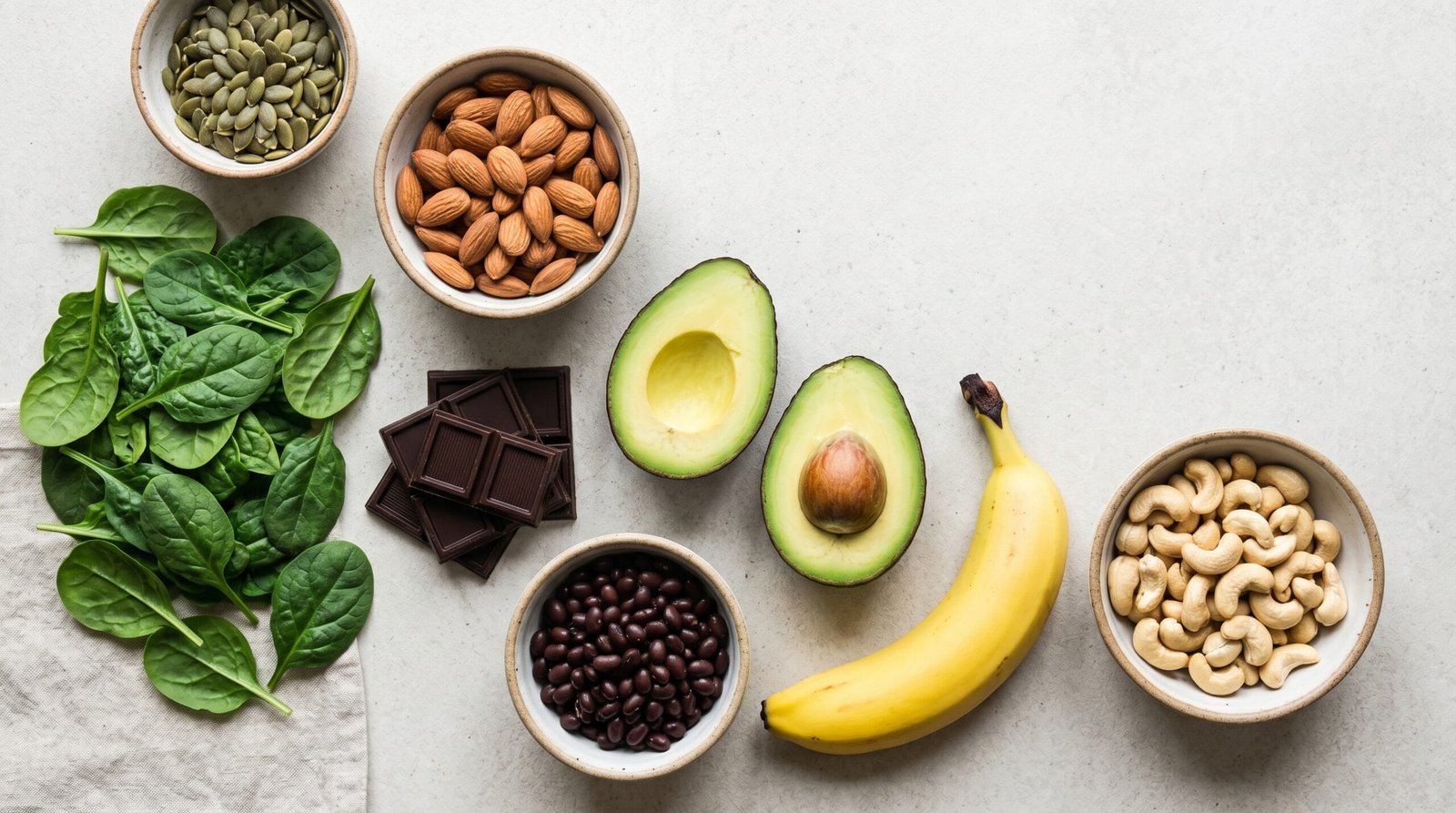
Before (and alongside) any supplement, I always start with food — it’s the foundation, and these foods bring fiber, antioxidants, and other nutrients a capsule can’t. Some of the best dietary sources of magnesium include:
- Pumpkin seeds — one of the richest sources, around 150 mg per ounce
- Dark leafy greens — spinach, Swiss chard, and kale
- Almonds, cashews, and peanuts
- Dark chocolate (70%+ cacao) — yes, really
- Avocado
- Black beans, edamame, and other legumes
- Whole grains like quinoa, brown rice, and oats
- Bananas and a few other fruits
- Fatty fish such as salmon and mackerel
A simple goal: aim to include a magnesium-rich food at most meals. A spinach-and-avocado salad topped with pumpkin seeds, a handful of almonds as a snack, or a square or two of dark chocolate after dinner all add up. For more ideas, my antioxidant-rich foods list overlaps with a lot of these nutrient-dense picks.
A Simple Magnesium-Powered Evening Wind-Down

Here’s the truth I keep coming back to: a supplement works best as part of a routine, not a replacement for one. This is the gentle evening sequence I recommend to ease your body into rest. And if your sleep reliably falls apart in the second half of your cycle, magnesium may not be the missing piece — low progesterone is often the driver.
- About 1–2 hours before bed, take your magnesium with a little water and, ideally, a small snack.
- Dim the lights and cut screens. Bright and blue light suppress melatonin, working against the very rhythm magnesium supports.
- Add a calming practice — a few minutes of slow breathing, gentle stretching, or one of these mindfulness techniques for a restful night.
- Keep your bedroom cool, dark, and quiet, and aim for a consistent bedtime — even on weekends.
The magnesium supplement I recommend
If you’d like to add a supplement, I look for a clean, highly absorbable magnesium glycinate — and the one I happily point readers to is Attain’s Magnesium Glycinate Capsules. Here’s why it fits everything we just covered:
- 275 mg of elemental magnesium in the glycinate form — right in the sweet spot for evening use.
- Chelated to glycine for superior absorption and a gentle effect on digestion (no laxative surprise).
- Clean and simple — non-GMO, vegan, gluten-free, with no artificial additives, made in the USA in a GMP-certified facility.
- Designed for bedtime — the suggested use is three capsules in the evening with water, exactly when you want that wind-down support.
It pairs beautifully with the calm-evening routine above. And if stress is your main sleep thief, you might also explore adaptogens like ashwagandha — just introduce one new thing at a time so you can tell what’s actually helping.
Who Should Be Careful With Magnesium
Magnesium is very safe for most healthy adults at recommended doses, but it isn’t right for everyone. Please check with your doctor before starting if you:
- Have kidney disease or impaired kidney function (your kidneys clear excess magnesium, so this matters most)
- Take medications such as certain antibiotics, diuretics, or heart and blood-pressure drugs
- Are pregnant or nursing
- Have a known medical condition or are unsure how it fits with your situation
The most common side effect of too much supplemental magnesium is loose stools — an easy sign you’ve gone a bit high and can dial back. As always here at Your Vitality Vibes, this is wellness education, not medical advice, and your doctor knows your individual picture best. If you want a broader primer on choosing quality products, my Supplements 101 guide is a good companion read.
Frequently Asked Questions
How long does magnesium take to work for sleep?
Some people feel a little more relaxed within the first few nights, but magnesium isn’t a sedative, so don’t expect to be knocked out instantly. The more meaningful benefits — falling asleep more easily and sleeping more deeply — usually build over 2–4 weeks of consistent daily use, especially if you were low to begin with.
What is the best form of magnesium for sleep?
Magnesium glycinate is my top recommendation for sleep. It’s highly absorbable, gentle on digestion, and bound to glycine — a calming amino acid that supports sleep on its own. Magnesium L-threonate and taurate are also good options, while magnesium oxide is poorly absorbed and citrate can have a laxative effect that disrupts rest.
When should I take magnesium for sleep?
Take it about 1–2 hours before bed, ideally with a small amount of food and a full glass of water. This timing supports absorption and lines up with your body’s natural wind-down toward sleep.
Can I take magnesium every night?
For most healthy adults, yes — daily use within recommended doses is considered safe and is actually how magnesium works best, since the benefits are cumulative. If you have kidney issues, take certain medications, or are pregnant or nursing, check with your doctor first.
Does magnesium help with anxiety as well as sleep?
Often, yes — and the two are deeply linked. By supporting GABA activity and helping regulate the stress response, magnesium can promote a calmer baseline, which naturally makes restful sleep easier. If anxiety is a big part of your sleep struggle, combining magnesium with calming practices tends to work better than either alone.
Can I just get magnesium from food instead of a supplement?
Absolutely, and food should always be the foundation. Leafy greens, pumpkin seeds, nuts, legumes, and dark chocolate are excellent sources. That said, because modern diets, soil depletion, and chronic stress make deficiency common, some people find a well-absorbed supplement helps them reach a level food alone isn’t providing. Food first, supplement to fill the gap.
The Bottom Line
Magnesium won’t magically fix your sleep overnight — but for the many of us who are quietly running low, it can be one of the gentlest, most genuinely useful pieces of the puzzle. It calms your nervous system, supports melatonin and a healthy stress response, and eases the physical tension that keeps you wired at bedtime.
If you want to give it a try, keep it simple: eat more magnesium-rich foods, choose a well-absorbed magnesium glycinate in the 200–350 mg range taken 1–2 hours before bed, and give it a consistent few weeks inside a calm evening routine. Start with that, be patient with yourself, and let your body relearn what deep rest feels like. You’ve got this — and I’d love to be part of your journey there.




[…] cortisol and disrupts the hormonal signaling that governs ovulation. If sleep is your weak link, magnesium for sleep and resetting your circadian rhythm naturally are the two most useful starting points on this […]
[…] If your mind races the moment your head hits the pillow, my guides on how to fall asleep fast and magnesium for sleep go […]
[…] to fall asleep fast and resetting your circadian rhythm naturally walk through the specifics, and magnesium for sleep covers a gentle supplement that helps many […]