
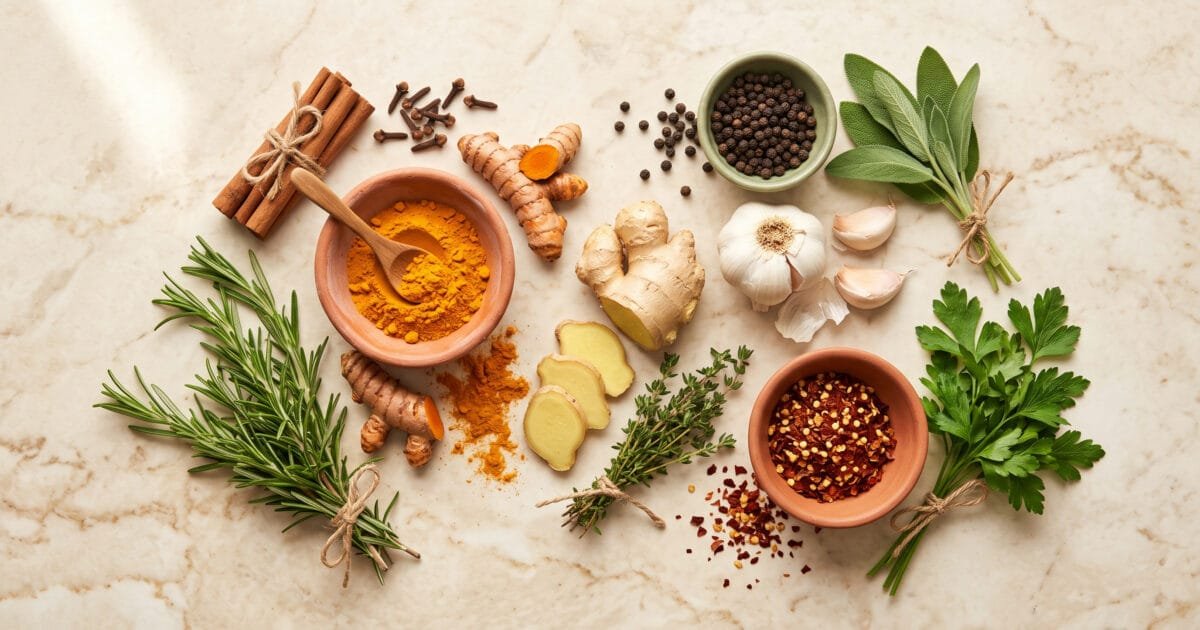
Hi, I’m Sophia. If you’ve ever gone looking for anti-inflammatory herbs and spices, you’ll have noticed the same thing I did: every article says roughly the same six things, in roughly the same confident tone, and almost none of them tell you how much you’d actually have to eat for any of it to matter.
So this is my attempt at the honest version. Sixteen herbs and spices worth having in your cupboard, what each one is actually doing, what the research does and doesn’t support, and — the part nobody covers — the gap between the amount used in a study and the amount that ends up in your dinner. Some of these have genuinely good evidence behind them. Some are in here because they make vegetables taste good enough that you’ll eat them, which turns out to matter more than people think.
What “Anti-Inflammatory” Actually Means for a Spice
Inflammation isn’t one thing. The short, sharp kind — a swollen ankle, a sore throat — is your immune system doing its job, and you don’t want to switch it off. The kind worth eating for is the low-grade, chronic sort that quietly persists in the background, and that Harvard Health links to a long list of chronic conditions, from heart disease and diabetes to arthritis.
When a plant compound is called anti-inflammatory, it usually means it interferes with one of a handful of signalling pathways. A 2016 review in Advances in Pharmacological Sciences laid out the main ones: inhibiting inflammatory cytokines such as TNF-α, IL-1β and IL-6, suppressing enzymes like COX-2, and modulating the NF-κB transcription factor. That’s the mechanism turmeric, ginger and rosemary all get credit for.
Which is real biochemistry. It is also mostly measured in cells in a dish, or in animals, or in humans given a concentrated extract — and that’s where the honest conversation has to start.
The Part Most Articles Skip: Dose
Here’s the thing I wish someone had told me earlier. Turmeric is roughly 3% curcumin by weight. A study showing an effect on joint pain might use 500 to 1,000 mg of curcumin a day. To get that from the spice jar you’d be eating somewhere in the region of two to four tablespoons of ground turmeric daily — which is not a recipe, it’s a dare. And curcumin is poorly absorbed on its own anyway, which is why black pepper keeps turning up next to it.
That gap between the study dose and the dinner dose applies to nearly everything on this page. So I want to be straightforward about what I think culinary herbs and spices are actually for:
- They add polyphenols to a diet, consistently, at no cost. Dried herbs and spices are among the most antioxidant-dense things in an ordinary kitchen by weight. Small amounts, most days, across years, are a real contribution — just not a dramatic one.
- They make anti-inflammatory eating survivable. The single biggest predictor of whether a way of eating helps you is whether you keep doing it. Herbs and spices are what stop a plate of vegetables and lentils from being a chore. That’s not a consolation prize; it might be the main effect.
- They replace things that aren’t helping. A spice-heavy dressing instead of a sugary sauce, chilli and lemon instead of extra salt. The substitution often matters more than the spice.
What they are not is medicine. If you want a therapeutic dose of curcumin or gingerol, you’re talking about a supplement, and that’s a conversation with a pharmacist or doctor rather than a shopping list — I’ve put the safety notes further down.
The Big Four: Best Evidence
These four have more human research behind them than everything else on this list combined. That doesn’t make them proven — it makes them the ones actually studied.
1. Turmeric
Active compound: curcumin (and other curcuminoids).
The most researched and the most oversold spice in the world. NCCIH’s read is careful: for osteoarthritis, “initial evidence is positive” but higher-quality studies are needed, and overall we don’t know enough to conclude that turmeric or curcumin is beneficial for any health purpose. They also flag two things worth knowing before you reach for a bottle: oral curcumin products vary a lot in how much curcumin they actually contain, and highly bioavailable formulations may harm the liver.
How I use it: half a teaspoon in scrambled eggs, lentil soup, rice or roasted cauliflower, always with black pepper and always with some fat in the pan — curcumin is fat-soluble.
2. Ginger
Active compounds: gingerols and shogaols.
Ginger has arguably the strongest evidence here, though not for the reasons it usually gets recommended. NCCIH reports that research supports ginger for nausea and vomiting in pregnancy, and that supplements might reduce the severity of menstrual cramps — both plausibly tied to its effect on inflammatory pathways. Oral supplements have shown some promise for knee osteoarthritis. Topical ginger has not. Most studies of ginger for motion sickness haven’t shown a benefit.
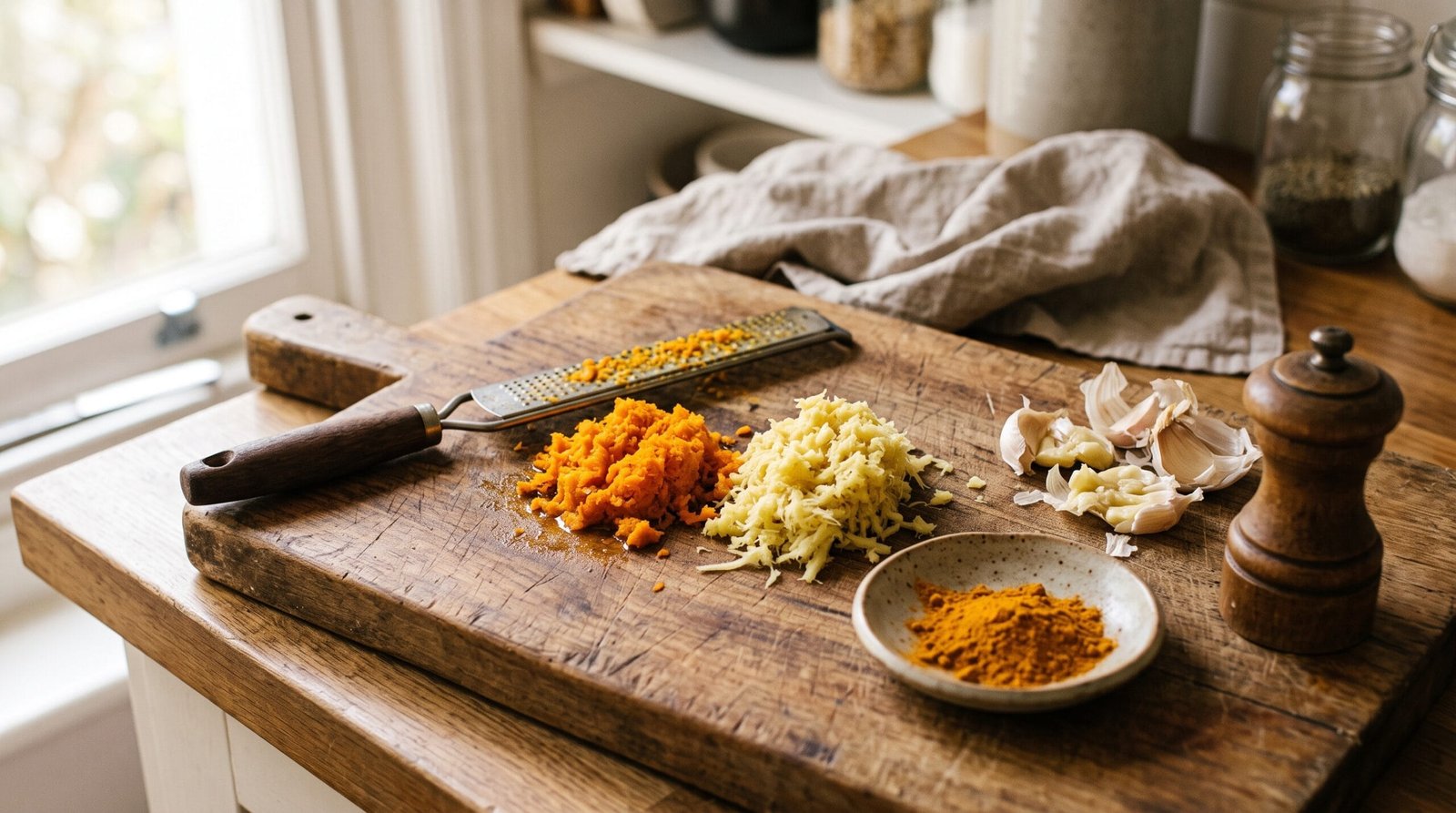
How I use it: grated fresh into stir-fries, dressings and tea; the dried version in baking and spice rubs. They aren’t interchangeable in flavour, and I keep both.
3. Garlic
Active compound: allicin, formed when garlic is crushed or chopped.
Garlic’s reputation runs well ahead of its evidence. On immune support specifically, NCCIH found that very little research has been done, and a 2022 review identified only two studies suggesting possible benefit — both small, both with methodological weaknesses. Its sulphur compounds are genuinely interesting and genuinely under-studied.
How I use it: crushed and left to sit for ten minutes before it goes in the pan, which gives the allicin time to form. And generously — this is the spice that makes the rest of the plate work.
4. Cinnamon (buy Ceylon)
Active compound: cinnamaldehyde, plus a dense set of polyphenols.
NCCIH is blunt: research doesn’t clearly support using cinnamon for any health condition. But there’s a safety point here that most articles genuinely miss, and it’s the reason cinnamon gets its own warning in my kitchen. The cassia cinnamon sold in most supermarkets contains coumarin, which can affect the liver, and some cassia products contain high levels of it. Ceylon cinnamon contains only trace amounts. If you have cinnamon occasionally, it doesn’t matter. If you have it in your oats every morning — as I do — buy Ceylon.
How I use it: oats, coffee, roasted squash, and in savoury braises where people don’t expect it.
The Everyday Kitchen Herbs
Less studied than the big four, and I’d rather say so than pretend otherwise. What they have going for them is polyphenol density and the fact that you can use them by the spoonful or the handful rather than the pinch — so the amounts actually add up.
5. Rosemary
Rich in rosmarinic and carnosic acids, and one of the herbs named in that 2016 review of anti-inflammatory herbal medicines. It also holds up to high heat far better than delicate herbs, which makes it the most practical thing to throw at a roasting tray. Chopped into potatoes, chicken, white beans or a tray of root vegetables.
6. Oregano
Carvacrol and thymol are the compounds of interest, and dried oregano is unusually dense in them. One of the few herbs where dried genuinely beats fresh, both in flavour concentration and in how much you end up using. A heavy pinch in tomato sauces, on roasted vegetables, through a dressing.
7. Thyme
Shares oregano’s thymol content and works in the same places — soups, braises, anything with mushrooms. It’s also about the easiest herb to keep alive on a windowsill, which matters more than it sounds: the herbs you use are the ones within arm’s reach.
8. Sage
Another rosmarinic-acid-rich herb from the same family as rosemary, and badly underused outside of autumn. Fried for thirty seconds in olive oil and spooned over white beans or pumpkin, it’s one of the best things you can do to a cheap ingredient.
9. Flat-Leaf Parsley
The most overlooked herb in most kitchens and the one I’d add to your shopping list first. It’s a genuine source of vitamin C — which the NIH notes functions as an antioxidant and plays a role in immune function — along with vitamin K and the flavonoid apigenin. Crucially, you can use a whole bunch at a time, so unlike most herbs the quantity is meaningful. Chopped through grain salads, soups and roasted vegetables at the very end.
10. Basil
Also high in rosmarinic acid, and the herb most likely to get used in quantity because pesto exists. Best added off the heat — its aromatics collapse the moment it hits a hot pan.
Heat and Aromatics
11. Cayenne and Chilli
Capsaicin has a real research literature behind it for pain — but the stronger findings involve topical capsaicin creams, not chilli in your dinner, and it’s worth not blurring the two. As a food, chilli earns its place for flavour and for the same reason as garlic: it makes a vegetable-heavy plate something you look forward to.
12. Black Pepper
Piperine, black pepper’s active compound, meaningfully improves curcumin absorption — which is the entire reason the turmeric-and-pepper pairing is repeated everywhere. It’s the one item on this list whose main value is what it does for another one. Grind it fresh; pre-ground pepper loses its aromatics fast.
13. Cloves
Cloves measure among the very highest-antioxidant spices by weight, thanks largely to eugenol. The catch is obvious once you’ve used them: you deploy cloves one or two at a time, so treat them as a bonus rather than a strategy. One or two in a pot of rice, a stew, or anything mulled.
14. Cardamom
Polyphenol-rich, expensive, and lovely. Crushed pods in rice, in coffee, in stewed fruit or a spiced tea. I include it with no grand claims — it’s here because it belongs in this cupboard and because it makes plain things taste considered.
The Ones You Drink
If your realistic route to more herbs is a mug rather than a pan, this is the section that matters.
15. Chamomile
Chamomile is likely safe in the amounts found in tea, and there’s preliminary research suggesting benefit for generalised anxiety — though NCCIH is clear that studies haven’t produced enough reliable evidence to rate its clinical usefulness. One real caution worth knowing: if you’re allergic to ragweed, chrysanthemums, marigolds or daisies, you’re more likely to react to chamomile. It can also interact with blood thinners and birth control pills.
16. Green Tea
Not a spice, but it belongs here. EGCG, its main catechin, is one of the better-studied plant polyphenols, and green tea is one of the few items on this page where a normal daily habit gets you a meaningful dose — because you drink it by the cup rather than the pinch. Two or three cups a day is an easy, unglamorous win.
A ginger-and-lemon infusion made with a thumb of fresh grated root is the other one I make constantly. It’s more ginger than you’d ever get into a meal, and it’s genuinely pleasant, which is most of the battle.
The Sixteen at a Glance
| Herb or spice | Main compound | Evidence in humans | Easiest way to use it |
|---|---|---|---|
| Turmeric | Curcumin | Most studied; NCCIH says not yet conclusive | ½ tsp in eggs, soup or rice, with pepper and fat |
| Ginger | Gingerols | Best on this list — nausea, menstrual cramps | Grated fresh into stir-fries, dressings, tea |
| Garlic | Allicin | Thin; only two small immune studies | Crushed, rested 10 minutes, then cooked |
| Cinnamon (Ceylon) | Cinnamaldehyde | Not clearly supported for any condition | Oats, coffee, roasted squash |
| Rosemary | Rosmarinic, carnosic acid | Mechanistic; little human data | Roasting trays — it survives high heat |
| Oregano | Carvacrol, thymol | Mechanistic | Dried, heavy pinch, in tomato sauces |
| Thyme | Thymol | Mechanistic | Soups, braises, mushrooms |
| Sage | Rosmarinic acid | Mechanistic | Fried in oil over beans or squash |
| Parsley | Apigenin, vitamin C | Nutrient contribution is real | A whole bunch, chopped, added at the end |
| Basil | Rosmarinic acid | Mechanistic | Off the heat, or as pesto |
| Cayenne / chilli | Capsaicin | Good for topical pain; dietary unclear | A pinch in anything savoury |
| Black pepper | Piperine | Clear role in curcumin absorption | Freshly ground, alongside turmeric |
| Cloves | Eugenol | Very high antioxidant density, tiny doses | One or two in rice or stew |
| Cardamom | Polyphenols | Limited | Crushed pods in rice, coffee, stewed fruit |
| Chamomile | Apigenin | Preliminary for anxiety; not conclusive | Tea — mind the ragweed allergy link |
| Green tea | EGCG | Well studied; realistic daily dose | Two or three cups a day |
Keeping Them Potent (The Bit Nobody Mentions)
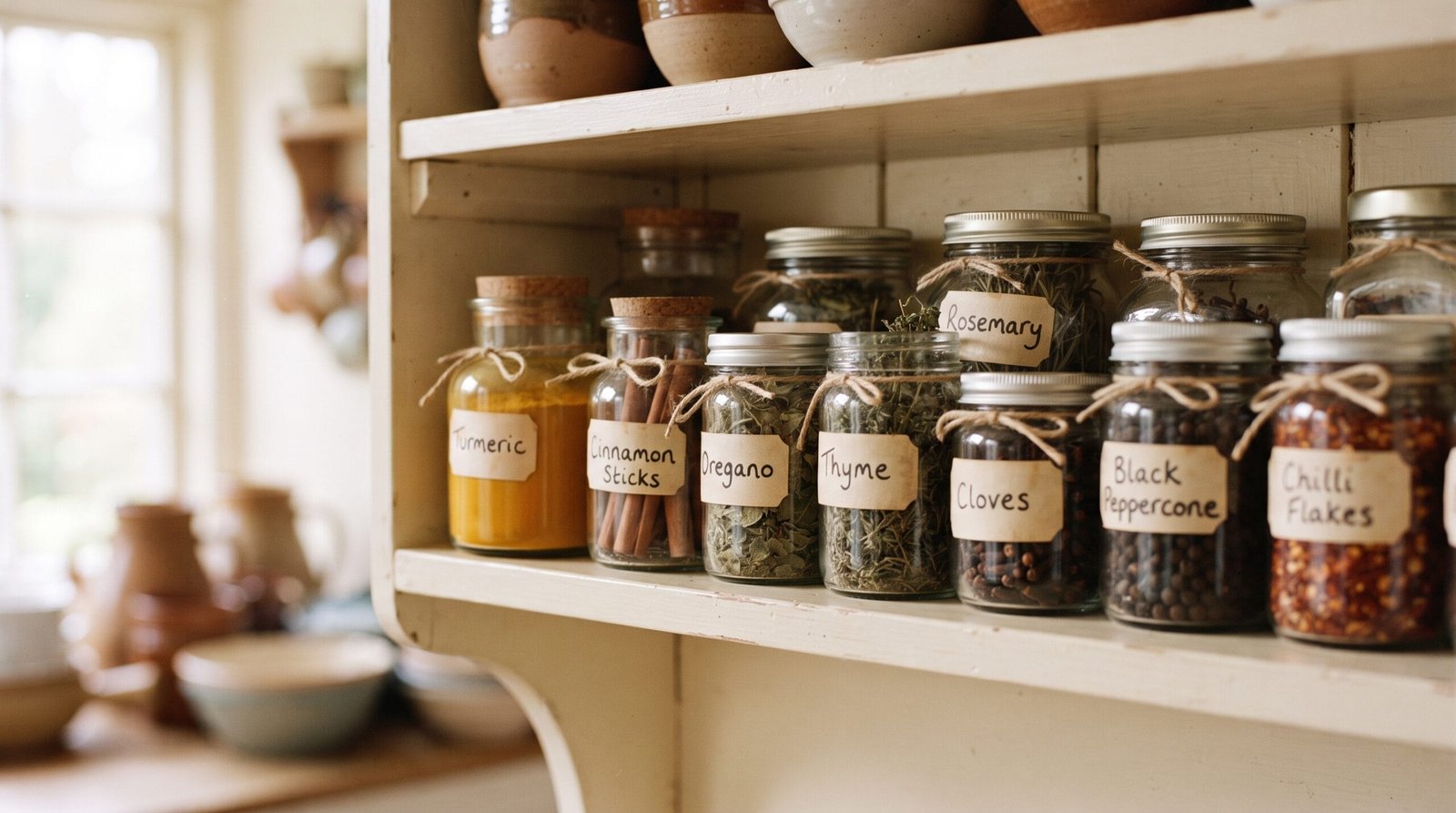
There’s not much point buying good turmeric if it then sits above the hob for three years. The polyphenols and volatile oils that make these worth eating are exactly the things that degrade with heat, light and air.
- Not above the cooker. The warmest, steamiest spot in the kitchen is the worst possible place, and it’s where almost everyone keeps their spice rack. A cool cupboard away from the hob is a genuine upgrade.
- Whole beats ground. Whole peppercorns, cumin seeds, cardamom pods and cinnamon sticks hold their oils for years; ground versions fade in months. Grind what you need.
- Buy small, replace often. Ground spices are worth replacing yearly. If you can’t smell it clearly with the lid off, it isn’t doing anything for you.
- Bloom them in fat. Warming ground spices in oil for thirty seconds before adding anything else pulls out far more flavour — and several of these compounds are fat-soluble, so it helps on both counts.
- Buy fresh herbs you’ll finish. Or grow thyme and rosemary, which are close to unkillable and cost the price of one supermarket packet.
Where to Start If You’re Buying From Scratch
Sixteen is a list, not a shopping trip. If you’re starting with an empty cupboard, this is the order I’d buy in:
- Black peppercorns and a grinder. Cheap, endlessly useful, and it makes the turmeric worth buying.
- Turmeric and fresh ginger. The two with the most behind them.
- Garlic. A bulb at a time, not the jar.
- Dried oregano and a rosemary plant. The two herbs that go furthest per pound spent.
- Ceylon cinnamon. Worth the small premium if you use it daily.
- Chilli flakes and a bunch of flat-leaf parsley. Heat and freshness, which is what most home cooking is short of.
That’s six purchases and it covers most of the useful ground. Everything else is refinement.
Spice Jar Versus Supplement
Everything above is about culinary amounts, and that distinction really matters. Concentrated extracts are a different product with a different risk profile: doses far beyond anything you’d eat, quality that varies enormously between brands, and real interaction potential.
- Blood thinners. Garlic, ginger, turmeric and chamomile have all been flagged for potential interactions. If you take warfarin or similar, this is a conversation to have before you start anything.
- Liver considerations. NCCIH notes that highly bioavailable curcumin formulations may harm the liver, and that prolonged high-dose cassia cinnamon is a concern for people with liver disease.
- Surgery. Several of these are commonly stopped a couple of weeks before an operation. Tell your surgical team what you’re taking.
- Pregnancy and breastfeeding. Culinary amounts are food. Supplement doses are not automatically safe, and for several of these the evidence simply isn’t there.
- Allergies. The chamomile-ragweed link above is the one people are most often caught out by.
None of that is a reason to avoid supplements. It’s a reason to treat them as what they are — something closer to medication than to seasoning — and to loop in a pharmacist, who is generally the most accessible expert on interactions that exists.
Where This Fits in the Bigger Picture
I’d hate for anyone to read this and come away thinking the spice cupboard is the lever. It isn’t. If you’re eating for inflammation, the things that move the needle are the shape of the whole diet — plenty of plants, oily fish, olive oil, fibre, not much ultra-processed food — plus sleep, movement and stress. My full anti-inflammatory foods list covers that ground properly, and the antioxidant-rich foods piece overlaps heavily with this one.
Two other things worth knowing. A large share of your immune and inflammatory activity is bound up with your gut microbiome, and fibre and fermented foods do more for that than any spice will. And chronic stress isn’t separate from this conversation — persistently elevated cortisol shapes inflammatory signalling too, which is why the unglamorous advice about sleep keeps turning up in articles about food.
Herbs and spices are the cheap, pleasant, low-effort layer on top of all that. Worth doing. Not worth mistaking for the foundation.
When to See a Doctor
Diet is not a treatment for an inflammatory condition. Please see a doctor rather than reaching for the spice rack if you have joint pain or swelling that persists for more than a few weeks, morning stiffness lasting over an hour, unexplained fevers, unintended weight loss, or fatigue that doesn’t lift with rest. Those can point to inflammatory arthritis or other conditions that need proper diagnosis and treatment — and the earlier they’re looked at, the better the outcomes tend to be. If you already have a diagnosis, talk to your team before adding any concentrated supplement, particularly alongside immunosuppressants or blood thinners.
Frequently asked questions
What is the strongest anti-inflammatory herb?
By weight of human research, ginger and turmeric are the two strongest candidates — ginger for the quality of its evidence, turmeric for the sheer volume of it. But “strongest” is doing a lot of work in that question. Neither has been shown to reliably treat an inflammatory condition at the amounts you’d get from cooking, and NCCIH’s position on turmeric is that we don’t yet know enough to conclude it’s beneficial for any health purpose.
What spices reduce inflammation?
The spices most consistently named in the research are turmeric, ginger, garlic, cinnamon, cloves, cayenne and black pepper, with rosemary, oregano, thyme and sage close behind on polyphenol content. They work through overlapping pathways — inhibiting inflammatory cytokines and COX-2, and modulating NF-κB — though most of that evidence comes from cell and animal studies rather than people eating dinner.
What reduces inflammation quickly?
Honestly, nothing on this page. Herbs and spices work at the level of a dietary pattern sustained over months, not as an acute intervention. If you need inflammation reduced quickly — an injury, a flare, an infection — that’s a medical question, and the answer is your doctor rather than your kitchen.
Which anti-inflammatory herbs work best as a tea?
Green tea, fresh ginger and chamomile are the three I’d pick, and they have a practical advantage over the rest of this list: you consume them by the cup rather than the pinch, so the amounts are meaningful. A thumb of grated fresh ginger steeped with lemon delivers far more ginger than any meal would. Turmeric tea is pleasant but poorly absorbed without fat and black pepper.
Is it better to take turmeric as a supplement or use the spice?
They’re doing different jobs. The spice contributes to a good overall diet at zero risk; a supplement delivers a study-sized dose along with real considerations around product quality, liver effects in highly bioavailable formulations, and interactions with blood thinners. I use the spice daily and would only consider a supplement in conversation with a doctor or pharmacist.
How long before an anti-inflammatory diet makes a difference?
Some markers shift within a few weeks; most of the meaningful change is measured over months. Which is exactly why I’d rather you picked three spices you enjoy and used them constantly than bought sixteen and abandoned them by October.
The Bottom Line
Anti-inflammatory herbs and spices are real, cheap, pleasant and modest. The biochemistry behind them is sound; the leap from that biochemistry to “this will fix your inflammation” is where most of the internet loses its footing, and I’d rather not join it.
Use them because they cost almost nothing, because they make the food you should be eating anyway taste like food you want to eat, and because small good habits compound. Buy the black pepper, grind it fresh, put it next to the turmeric. Then go to bed on time — which will do more for your inflammatory markers than the entire spice cupboard combined.
Wellness education, not medical advice. Always consult a qualified healthcare professional before starting a supplement or making significant dietary changes, especially if you have a health condition or take medication.

[…] Anti-Inflammatory Herbs and Spices: 16 Worth Using says: August 31, 2026 at 1:38 pm […]
[…] to tell you it’s doing more than that. I’ve gone into this properly in my guide to anti-inflammatory herbs and spices, including how far a culinary dose really gets […]