
Hi, I’m Sophia. If you’ve been dragging through your afternoons, reaching for a fourth coffee, and wondering why you’re “tired all the time” despite sleeping fine, low iron is one of the most common — and most commonly missed — explanations, especially if you’re a woman who has periods. It’s also one of the easiest things to actually confirm with a simple blood test, which is more than I can say for a lot of wellness topics I write about.
I want to be upfront about something before we dive in: iron is one of the few supplements where more isn’t automatically better, and taking it without testing first can actually cause harm. So consider this your honest, evidence-based starting point — the real signs, why it’s so common in women specifically, how it’s actually diagnosed, and what genuinely helps once you know what you’re dealing with.
What iron deficiency actually is
Iron deficiency isn’t all-or-nothing — it happens in stages. First, your stored iron (measured as ferritin) starts to drop while your red blood cells are still normal. Left unaddressed, it progresses to iron deficiency without anemia, where stores are low enough to cause symptoms even though your hemoglobin still tests “normal.” Eventually, if it continues, you develop iron deficiency anemia, where your body can’t make enough healthy red blood cells to carry oxygen efficiently.
This matters because a lot of people feel noticeably unwell in that middle stage — low ferritin, normal hemoglobin — and get told their bloodwork is “fine” because whoever ordered the test only checked a basic complete blood count (CBC) and skipped ferritin. If you suspect low iron, ferritin is the test you actually need.
Signs and symptoms of iron deficiency
Iron carries oxygen throughout your body, so when it’s low, pretty much everything that depends on oxygen delivery — your energy, your brain, your muscles — feels it. Here’s what to watch for:
- Persistent fatigue and weakness that doesn’t fully resolve with sleep
- Pale skin, or pale inner eyelids and gums
- Shortness of breath with activity that used to feel easy
- Rapid or noticeable heartbeat, especially with exertion
- Cold hands and feet
- Headaches and difficulty concentrating (“brain fog”)
- Brittle nails or nails that curve upward (koilonychia, in more advanced cases)
- Hair thinning or increased shedding
- Restless legs, particularly at night
- Unusual cravings for ice, dirt, or starch (a specific and fairly telling symptom called pica)
- Sore or unusually smooth tongue
No single symptom confirms iron deficiency on its own, but persistent fatigue plus two or three of the others — especially pica, restless legs, or pale inner eyelids — is a genuinely useful pattern to bring to your doctor.
Why this is so common in women specifically
Iron deficiency is significantly more common in women than men, and it isn’t random — it comes down to blood loss and demand:
- Menstruation. Regular periods are the single biggest reason women need roughly double the daily iron of men. Heavy periods (menorrhagia) — soaking through a pad or tampon in under two hours, passing large clots, or bleeding longer than seven days — can push iron losses well beyond what diet replaces.
- Pregnancy. Blood volume expands significantly and the growing baby draws on maternal iron stores, which is why iron needs nearly double during pregnancy.
- Perimenopause. Shifting hormones can cause heavier or more unpredictable periods before they taper off — if you’re noticing both fatigue and irregular heavy bleeding, it’s worth reading my perimenopause symptoms guide alongside this one, since the two can overlap.
- Lower dietary intake. Diets lower in heme iron (the more absorbable form, found in animal foods) — including vegetarian and vegan diets — require more intentional planning to hit iron targets, though they absolutely can with the right foods.
Other causes worth knowing about, regardless of gender: gastrointestinal conditions that impair absorption (celiac disease, inflammatory bowel disease, prior gastric surgery), frequent blood donation, endurance training (heavy exercise can modestly reduce iron absorption and increase losses), and, less commonly, slow internal bleeding — which is why unexplained iron deficiency in anyone who isn’t menstruating heavily deserves a doctor’s attention rather than just a supplement.
How iron deficiency is actually diagnosed
This is genuinely simple to check, which is exactly why it’s worth doing before spending money on symptoms guesswork. A doctor will typically order:
- Ferritin, the best single marker of your stored iron — this is the one most likely to be skipped on a routine panel, so ask for it by name
- Complete blood count (CBC), which shows hemoglobin, hematocrit, and red blood cell size (small, pale red cells are a classic sign of iron deficiency anemia)
- Transferrin saturation (TSAT) and total iron-binding capacity (TIBC), which help confirm the picture and rule out other causes of anemia
If your ferritin comes back low, it’s also worth asking your doctor about the “why” — particularly whether heavy periods or a GI cause should be investigated — rather than treating the low number in isolation.
What actually helps
Food first
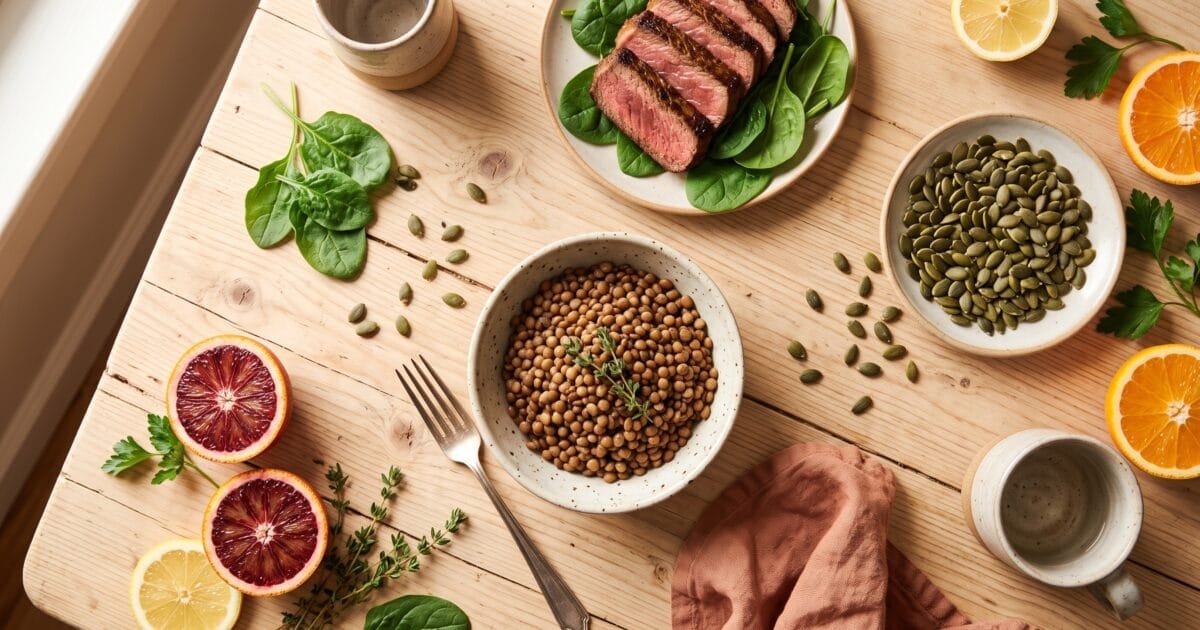
Heme iron, found in red meat, poultry, and seafood, is absorbed considerably more efficiently than non-heme iron from plants. If you eat meat, oysters, clams, red meat, and dark poultry meat are among the most concentrated sources. If you’re vegetarian, vegan, or just want to eat more plants, lean on lentils, beans, tofu, dark leafy greens, fortified cereals, and pumpkin seeds — and pair them with a source of vitamin C (citrus, bell peppers, strawberries) in the same meal, which meaningfully boosts non-heme iron absorption.
A few practical habits that make a real difference: avoid drinking coffee or tea right alongside iron-rich meals (the tannins bind iron and reduce absorption — give it an hour on either side), and if you take a calcium supplement, take it at a different time of day than your iron-rich meals or iron supplement, since calcium competes with iron for absorption.
Test before you supplement
I want to be direct about this because it’s genuinely important: unlike most supplements, iron is not something to take “just in case.” Iron overload is a real and serious risk — your body has no efficient way to get rid of excess iron, and it can accumulate in the liver, heart, and other organs over time. This is especially important if you’re male, postmenopausal, or have a family history of hemochromatosis (a genetic condition that causes excess iron absorption), since your baseline risk of overload is higher and your need for supplemental iron is often lower or nonexistent.
The right sequence is: get your ferritin tested, confirm with your doctor that supplementation makes sense for you, and let them help you choose a dose and form. If that applies to you, some people find sublingual or dissolvable iron formats gentler on the stomach than traditional iron pills, which are notorious for causing constipation and nausea — Attain’s Iron Support Strips, a sublingual iron-and-folate strip, is one option worth asking your doctor about if you’ve struggled to tolerate iron pills in the past. But the supplement is the last step here, not the first — the testing comes before the shopping.
Whatever iron supplement you and your doctor land on, take it as directed, keep it away from children (iron overdose is a leading cause of pediatric poisoning deaths), and don’t combine multiple iron sources without medical guidance.
Support the fundamentals while you sort it out
Fatigue rarely has just one cause. While you’re getting iron sorted out, the same foundational habits that support energy generally are worth keeping in place — consistent sleep, morning light, and steady meals, which I cover in more depth in my morning habits for energy guide. And if fatigue and stress feel tangled together, my comparison of ashwagandha vs. rhodiola covers two well-studied options for the stress side of the equation — though neither replaces treating an actual iron deficiency. And if you’re also strength training, it’s worth knowing that creatine for women supports muscle and recovery through a completely different mechanism — it’s not a substitute for correcting low iron, but it’s a reasonable complement once your levels are actually sorted out.
Low iron vs. other common fatigue culprits
Fatigue overlaps across a lot of conditions I write about, which is exactly why testing beats guessing. A quick comparison:
| Low iron | Low cortisol | Low progesterone | Low B12 | |
|---|---|---|---|---|
| Key test | Ferritin, CBC | Morning cortisol, ACTH stim | Mid-luteal progesterone | Serum B12 ± MMA |
| Distinctive signs | Pica, restless legs, pale inner eyelids | Salt cravings, dizziness on standing | Short cycles, spotting, anxiety before periods | Tingling/numbness, balance issues |
| Who’s most at risk | Women with heavy periods, pregnant women, vegetarians | Steroid users, rare autoimmune cases | Perimenopausal women, luteal phase defects | Vegans/vegetarians, adults 50+, metformin users |
If you’ve already read my guides on low cortisol symptoms, low progesterone symptoms, vitamin B12 deficiency, or vitamin D deficiency and nothing quite fit, low iron is worth ruling in or out next — it’s one of the more common and most straightforward-to-test explanations for persistent fatigue in women.
When to see a doctor promptly
Most iron deficiency is not an emergency, but a few signs deserve prompt medical attention rather than a wait-and-see approach: chest pain or a racing heart at rest, fainting, black or tarry stools (a possible sign of GI bleeding), very heavy menstrual bleeding that’s soaking through protection hourly, or fatigue severe enough to interfere with daily functioning. These warrant a same-week appointment rather than waiting it out.
Frequently asked questions
What are the first signs of low iron?
Persistent fatigue, pale skin or inner eyelids, and shortness of breath with light activity are usually the earliest, most noticeable signs. Cravings for ice (pica) and restless legs are less common but more specific to iron deficiency.
Why are women more likely to be iron deficient?
Menstruation is the biggest reason — women lose iron every cycle, and heavy periods can outpace what a typical diet replaces. Pregnancy and perimenopausal bleeding changes add to the risk.
Should I just start taking an iron supplement to be safe?
No — please get tested first. Iron overload is a real risk since your body can’t easily eliminate excess iron, and supplementing without knowing your levels can do more harm than good, especially for men and postmenopausal women.
What foods are highest in iron?
Oysters, red meat, and dark poultry meat are among the most concentrated heme iron sources. Lentils, spinach, tofu, fortified cereals, and pumpkin seeds are strong non-heme options — pair them with vitamin C to boost absorption.
How long does it take to fix low iron?
With appropriate treatment, energy often improves within a few weeks, but rebuilding iron stores (ferritin) fully can take three to six months. Your doctor will likely recheck levels at that point.
Related Reading
- Vitamin B12 Deficiency: Signs, Causes, and What Actually Helps
- Vitamin D Deficiency: Signs, Causes, and What Actually Helps
- Creatine for Women: Benefits, Dosage, and the Truth About Weight Gain
- Maximizing Plant-Based Proteins in Your Diet
- Healthy Snack Ideas: 30 Easy Options for Energy and Focus
The bottom line
If you’re exhausted, pale, and craving ice out of nowhere, low iron is a genuinely common and genuinely fixable explanation — but “fixable” starts with a ferritin test, not a supplement bottle. Get the bloodwork, understand the why (especially if it’s heavy periods), and work with your doctor on the right food and supplementation plan for your specific numbers. It’s one of the more satisfying things to sort out, because unlike a lot of fatigue causes, this one usually has a clear answer and a clear fix.
Wellness education, not medical advice. Please talk to your doctor before starting any iron supplement, especially if you are male, postmenopausal, or have a family history of hemochromatosis.
⚕️ Disclaimer: This article is for general informational and educational purposes only and is not a substitute for professional medical advice, diagnosis, or treatment. Always consult a qualified healthcare provider before making changes to your diet, exercise, supplement, or wellness routine. Read our full medical disclaimer.

[…] fix a fatigue-causing nutrient deficiency. It’s worth ruling out common culprits like low iron or vitamin B12 deficiency first, especially if fatigue — rather than strength or recovery — is […]
[…] packs a punch with significant iron and copper amounts. That matters on a plant-based diet, where low iron symptoms can build […]
[…] You’re losing iron through menstrual blood, so this is a good window to lean into iron-rich foods — leafy greens, lentils, red meat if you eat it, paired with vitamin C to help absorption. Warm, easy-to-digest meals (soups, stews, roasted vegetables) tend to feel better than raw, cold foods for a lot of women during this phase. If fatigue during your period feels disproportionate, it’s worth a look at my guide to low iron symptoms. […]