

Hi, I’m Sophia. If you’ve been Googling “why do I feel like this before my period,” there’s a good chance progesterone came up somewhere in the results — and then left you with more questions than you started with. It’s one of the least understood hormones, mostly because it does its work quietly, in the second half of your cycle, and only gets noticed when it’s running low.
I’m a wellness writer and researcher, not a clinician, so nothing here is a diagnosis. What I can do is walk you through what progesterone actually does, the signs that tend to show up when it’s low, what causes it, and which of the natural approaches people recommend are actually backed by evidence — versus which ones are just confidently repeated online.
What progesterone actually does
Progesterone is produced mainly by the corpus luteum — the structure left behind after an ovary releases an egg — during the second half (luteal phase) of your menstrual cycle. Its main job is to prepare and stabilize the uterine lining for a possible pregnancy. If pregnancy doesn’t happen, progesterone drops, which is what triggers your period. If it does happen, the placenta eventually takes over progesterone production to sustain the pregnancy.
Beyond reproduction, progesterone has a calming effect on the nervous system. It’s converted in the brain into a compound called allopregnanolone, which interacts with the same GABA receptors targeted by anti-anxiety medications. That’s the biological thread connecting low progesterone to feeling more anxious, wired, or unable to switch off in the days before your period — it’s not “just in your head,” according to the Johns Hopkins Medicine overview of progesterone.
Common signs of low progesterone
None of these symptoms are exclusive to low progesterone — several overlap with thyroid issues, high cortisol, or perimenopause, which is exactly why testing (not a symptom checklist) is what actually confirms it. But if several of these are consistently showing up in the two weeks before your period, it’s worth paying attention to:
- Short or irregular cycles — a luteal phase (ovulation to period) shorter than about 10 days can signal insufficient progesterone
- Spotting before your period — the lining isn’t being held as stable as it should be
- Worsening PMS — irritability, anxiety, or low mood concentrated in the days before your period, then easing once it starts
- Trouble sleeping premenstrually — since allopregnanolone (made from progesterone) supports deeper, calmer sleep; I go deep on the mechanism and what helps in period insomnia
- Heavier or longer periods — unopposed estrogen (relative to progesterone) can overbuild the uterine lining
- Breast tenderness in the luteal phase
- Headaches that cluster right before your period
- Difficulty conceiving or early miscarriage — progesterone is essential for maintaining early pregnancy, which is why it’s checked in fertility workups
If your cycles have stopped, become very irregular, or you’re trying to conceive and these symptoms are present, that’s a conversation for your doctor rather than a supplement aisle.
What actually causes low progesterone
Progesterone doesn’t drop for no reason. The common drivers, in roughly the order I hear about them from readers:
| Cause | What’s happening |
|---|---|
| Perimenopause | Progesterone is usually the first hormone to decline as ovulation becomes less consistent in your late 30s and 40s — often years before estrogen levels drop. This is covered in depth in my perimenopause symptoms guide. |
| Anovulatory cycles | If you don’t ovulate in a given cycle — common with PCOS, high stress, or being newly off hormonal birth control — no corpus luteum forms, so no progesterone is made that cycle. |
| Chronic stress and high cortisol | Progesterone and cortisol share a production pathway. Under sustained stress, the body can prioritize cortisol production, a dynamic sometimes called “pregnenolone steal.” I go deeper on the stress-hormone connection in high cortisol symptoms. |
| Under-eating or over-exercising | When energy availability is too low for too long, the body downregulates reproductive hormones, ovulation becomes irregular, and progesterone falls with it. |
| Thyroid dysfunction | Hypothyroidism can disrupt ovulation and luteal function. Thyroid testing (TSH, free T4) is a standard part of any real hormone workup. |
| PCOS | Irregular or absent ovulation is a hallmark of polycystic ovary syndrome, which means irregular or low progesterone as a direct consequence. |
How it’s actually tested — and why timing matters so much
This is the part most people get wrong, often through no fault of their own. Progesterone isn’t flat across your cycle — it’s close to zero for the first half, then rises sharply after ovulation and falls again before your period. A blood test drawn at the wrong time will look “low” simply because it was never going to be high that day.
The standard approach is a blood draw about 7 days after ovulation (roughly day 21 of a textbook 28-day cycle, though this shifts if your cycle is longer or shorter, or if you don’t ovulate on a predictable day). If you have irregular cycles, your doctor may use ovulation predictor kits or basal body temperature tracking to time the test more accurately, or run it more than once. A single random draw, especially one not timed to ovulation, isn’t a reliable way to diagnose anything on its own — the American College of Obstetricians and Gynecologists is a good source if you want to understand how cycle-related hormone testing is actually approached.
What genuinely helps
Lifestyle changes won’t manufacture progesterone out of nowhere — your body makes what it makes based on whether and how well you ovulate. But several inputs affect ovulation quality and luteal function, and they’re worth getting right before reaching for anything else.
Eat enough, consistently
This is the single most common fixable cause I hear about. Chronic under-eating — whether intentional or just a busy-life accident — signals scarcity to your body, and reproductive function is one of the first things it deprioritizes. If your periods have become irregular or light alongside dieting or heavy training, more food (not more discipline) is usually the actual fix.
Get a handle on chronic stress
Given the shared production pathway between cortisol and progesterone, managing chronic stress isn’t a soft recommendation here — it’s mechanistically relevant. My guide to how to lower cortisol naturally covers the approaches with the best track record, and it’s the same short list every time: consistent sleep, a few minutes of slow breathing daily, and genuine downtime that isn’t scrolling.
Protect your sleep
Poor sleep raises cortisol and disrupts the hormonal signaling that governs ovulation. If sleep is your weak link, magnesium for sleep and resetting your circadian rhythm naturally are the two most useful starting points on this site.
A note on seed cycling
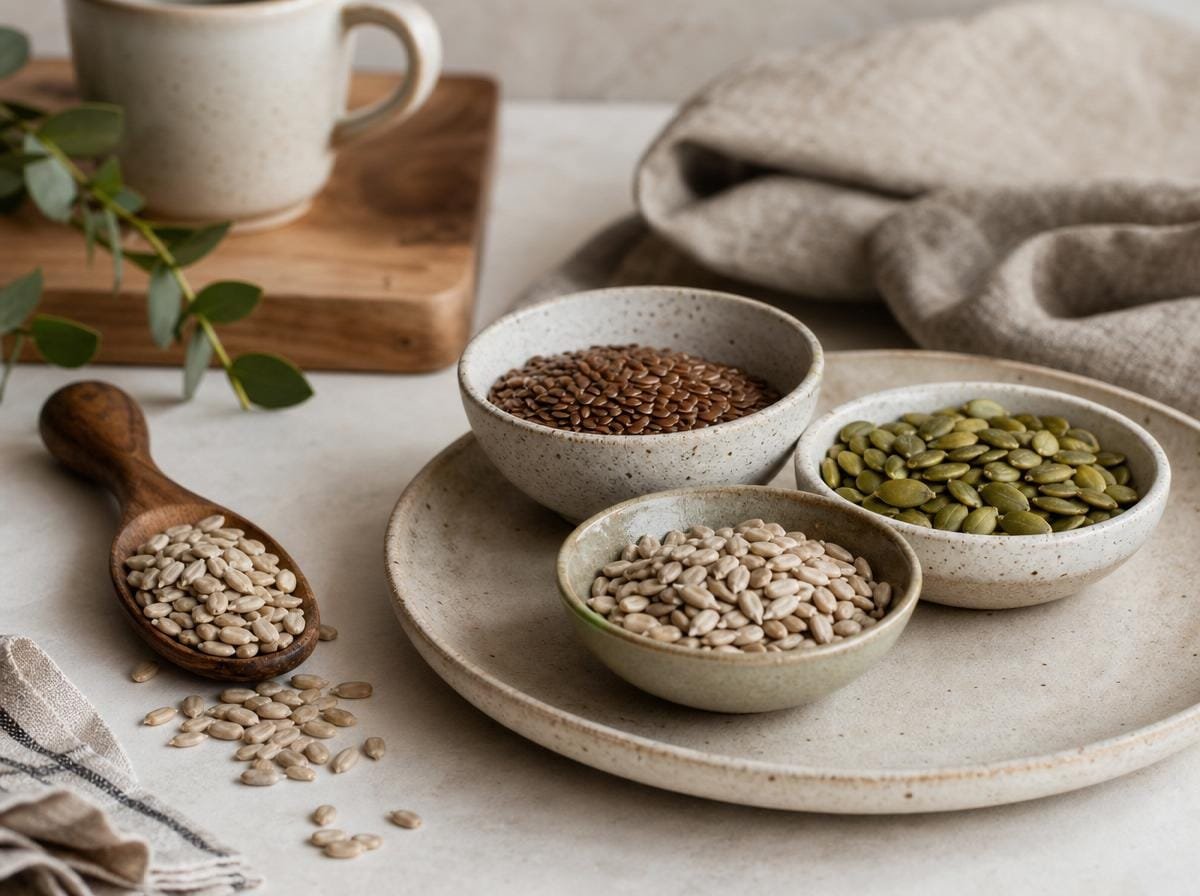
Seed cycling — eating flax and pumpkin seeds in the first half of your cycle, then sesame and sunflower in the second — comes up constantly in this conversation. I looked at the actual evidence in does seed cycling really work, and the honest answer is: the seeds are nutritious, but there’s essentially no evidence that the specific timing shifts progesterone or estrogen levels. Worth doing for the nutrition, not as a fix for low progesterone. Much the same applies to cycle syncing your food and workouts — a sensible way to structure the month around how you feel, but not a lever that raises progesterone on its own.
Supplements, graded honestly
Here’s how I’d grade what actually comes up in this conversation — including the popular one that doesn’t have the evidence people assume it does.
| Supplement | Evidence | What it’s reasonably for | What it doesn’t do |
|---|---|---|---|
| Vitex (chasteberry) | Mixed, mostly small trials | Some studies suggest it may support luteal phase length and ease PMS symptoms in certain people, likely via an effect on prolactin rather than a direct progesterone boost | It is not a guaranteed fix, works over months not days, and can interact with hormonal medications and birth control — talk to your doctor before starting it, especially if you’re on any hormonal treatment |
| Magnesium | Moderate | Correcting a common shortfall; modest support for sleep quality and PMS-related mood and cramping | Doesn’t raise progesterone directly |
| Ashwagandha | Mixed but promising | Lowering perceived stress and cortisol over 6–8 weeks in several small trials, which matters given the cortisol-progesterone link above | Avoid in pregnancy; use caution with thyroid or autoimmune conditions |
| Vitamin B6 | Limited but longstanding | Some evidence for easing PMS symptoms | Not shown to directly change progesterone levels |
| Progesterone cream (OTC) | Poor regulation, inconsistent dosing | Not something to start on your own — actual bioidentical progesterone is a prescription decision made with a doctor based on real lab work | Over-the-counter “progesterone creams” are not a substitute for medical evaluation, and dosing on unregulated products is unreliable |
If stress is genuinely part of your picture — and for most people juggling a full life, it is — the two I’d actually reach for are magnesium in the evening and ashwagandha during a stressful stretch. Attain Supplements, our sister brand, makes both: their Magnesium Glycinate Capsules ($27.99) use the well-absorbed, gut-gentle glycinate form, and their Ashwagandha Root Capsules with Black Pepper ($24.99) are what I’d point you to if cortisol looks like the bigger piece of your puzzle — I compared it against another popular adaptogen in ashwagandha vs. rhodiola. Disclosure: Attain Supplements is part of our family of brands, so we may earn from purchases made through these links. Attain doesn’t currently carry a vitex product, so if you and your doctor decide vitex is worth trying, look for a reputable, well-reviewed single-ingredient option rather than a random blend — Gaia Herbs’ Vitex Berry (Organic Chaste Tree) is a long-standing, widely-reviewed option. (This is an Amazon affiliate link — we may earn a small commission on qualifying purchases, at no extra cost to you.) Please talk to your doctor before adding any supplement, especially vitex, if you’re on hormonal birth control, trying to conceive, or managing a diagnosed condition.
When to see a doctor
Please book an appointment rather than self-managing if you have periods that have stopped or become very irregular, are trying to conceive without success after six to twelve months (or sooner if you’re over 35), have had recurrent early miscarriage, or have PMS symptoms severe enough to disrupt your work or relationships. A proper workup — timed bloodwork, a thyroid panel, and a real conversation about your cycle history — will tell you far more than any symptom list, including this one.
Frequently asked questions
FAQ
What are the first signs of low progesterone?
Can stress cause low progesterone?
How can I raise my progesterone naturally?
Does low progesterone cause weight gain?
Is low progesterone the same as perimenopause?
The Bottom Line
Low progesterone symptoms — a short or irregular cycle, worsening PMS, disrupted sleep before your period, spotting — are real and worth taking seriously, but a symptom list can only point you toward a question, not answer it. Timed bloodwork with your doctor is what actually confirms what’s going on. In the meantime, the highest-leverage things you control are eating enough, managing chronic stress, and protecting your sleep, since all three influence whether you ovulate well in the first place. Supplements like magnesium and ashwagandha support that foundation; they don’t replace it, and nothing here replaces a real conversation with your doctor if your cycle has changed or you’re trying to conceive.
⚕️ Disclaimer: This article is for general informational and educational purposes only and is not a substitute for professional medical advice, diagnosis, or treatment. Always consult a qualified healthcare provider before making changes to your diet, exercise, supplement, or wellness routine, especially if you are pregnant, trying to conceive, or managing a diagnosed condition. Read our full medical disclaimer.


[…] you’ve already read my guides on low cortisol symptoms, low progesterone symptoms, vitamin B12 deficiency, or vitamin D deficiency and nothing quite fit, low iron is worth ruling in […]
[…] you already know your numbers are off in one direction, it’s worth reading my guides to low progesterone symptoms and low estrogen symptoms — cycle syncing is a lifestyle framework, not a substitute for getting […]