

HIIT — High-Intensity Interval Training — has become the most efficient workout method for burning fat, building cardiovascular fitness, and saving time. But with so much conflicting advice online, it’s hard to know where to start, how hard to push, or how to structure a real HIIT program.
This guide covers everything you need: what HIIT actually is, the science behind why it works, beginner and advanced workouts you can do today, and a complete 4-week program to follow.
What Is HIIT? The Simple Definition
High-Intensity Interval Training alternates short bursts of maximum-effort exercise with brief recovery periods. A typical pattern might be 40 seconds of hard work followed by 20 seconds of rest, repeated for 15–30 minutes.
What makes HIIT different from regular cardio is the intensity during those work intervals. You’re not jogging — you’re sprinting, jumping, or pushing close to your maximum effort. This intensity is what triggers the physiological adaptations that make HIIT uniquely effective.
The Science Behind Why HIIT Works
EPOC: The Afterburn Effect
The most significant advantage of HIIT over steady-state cardio is Excess Post-Exercise Oxygen Consumption — the “afterburn effect.” After a HIIT session, your body continues burning calories at an elevated rate for 12–24 hours as it restores oxygen levels, removes metabolic byproducts, and repairs micro-damaged muscle tissue. Research from the American College of Sports Medicine found that HIIT can elevate metabolic rate by 6–15% for up to 24 hours post-exercise. A 20-minute HIIT session can ultimately burn more total calories than a 40-minute moderate jog.
Fat Burning Without Muscle Loss
Prolonged steady-state cardio can break down muscle tissue for fuel, especially in a caloric deficit. HIIT preserves muscle while targeting fat stores — a critical distinction for body composition. A 2017 meta-analysis in the British Journal of Sports Medicine confirmed that HIIT produces similar or greater fat loss than moderate-intensity continuous training in significantly less time, while better preserving lean muscle mass.
Cardiovascular and Metabolic Benefits
HIIT dramatically improves VO2 max (your cardiovascular capacity), insulin sensitivity, blood pressure, and cholesterol levels. Studies show 8 weeks of HIIT can improve VO2 max as much as 12–16 weeks of moderate continuous training. For busy people, this time efficiency is a game-changer.

HIIT vs. Cardio: Which Is Better?
| Factor | HIIT | Steady-State Cardio |
|---|---|---|
| Time required | 15–30 minutes | 45–60+ minutes |
| Calories burned during | Moderate–High | Moderate |
| Afterburn effect | High (12–24 hrs) | Low |
| Fat loss | Excellent | Good |
| Muscle preservation | Better | Moderate |
| VO2 max improvement | Excellent | Good |
| Joint stress | Higher (impact) | Lower |
| Recovery needed | More (48 hrs) | Less |
| Best for | Fat loss, fitness, time efficiency | Recovery days, beginners, low-impact needs |
The verdict: HIIT is more time-efficient for fat loss and fitness gains. But steady-state cardio has its place — particularly on recovery days, for beginners, or for those with joint issues. The best training plan often includes both.
How to Do HIIT: The Key Principles
Work-to-Rest Ratios
The most important variable in HIIT is your work-to-rest ratio. Different ratios produce different training effects:
- 1:3 ratio (e.g., 20 sec work / 60 sec rest) — Best for beginners or all-out maximum effort sprints. Full recovery between intervals.
- 1:2 ratio (e.g., 30 sec work / 60 sec rest) — The most common beginner-to-intermediate structure. Sustainable for full workouts.
- 1:1 ratio (e.g., 40 sec work / 40 sec rest) — Intermediate to advanced. Higher cardiovascular demand.
- 2:1 ratio (e.g., 40 sec work / 20 sec rest) — Advanced. Very high demand — best for well-conditioned athletes only.
Intensity: How Hard Should You Push?
During work intervals, you should be at 80–95% of your maximum heart rate. A practical test: you should only be able to say 2–3 words at a time. If you can hold a conversation, you’re not working hard enough. If you feel dizzy or can’t continue, you’ve pushed too far.
For beginners: aim for a 7–8 out of 10 on perceived exertion during work intervals. For advanced: 8–9 out of 10. True HIIT is uncomfortable — that discomfort is the signal that it’s working.
How Many Days Per Week?
This is where most people make a critical mistake. More HIIT is not better. Each HIIT session stresses the central nervous system and requires 48 hours of recovery:
- Beginners: 2 sessions per week maximum
- Intermediate: 3 sessions per week
- Advanced: 3–4 sessions per week maximum
Doing daily HIIT raises cortisol, increases injury risk, and leads to diminishing returns. Fill the remaining days with lighter activity: walking, yoga, strength training, or steady-state cardio. If you’re in perimenopause, HIIT’s cortisol spike can feel more pronounced than it used to — pairing 2 HIIT sessions with 1-2 gentler days (yoga or a walk) often works better than pushing HIIT daily; my guide to strength training for women over 40 covers a realistic weekly mix. If you’re adding strength sessions, creatine for women is one of the few supplements with solid evidence behind it.
5 Types of HIIT Workouts
1. Tabata
The original HIIT protocol, developed by Dr. Izumi Tabata. Structure: 20 seconds maximum effort, 10 seconds rest, repeated 8 times = 4 minutes. Typically 4–8 rounds total (16–32 minutes). Extremely efficient but brutally intense. Best for intermediate to advanced.
2. Standard Interval Training
30–60 second work intervals with 60–90 second rest. More accessible for beginners while still delivering HIIT benefits. Easiest to adapt to any exercise modality.
3. EMOM (Every Minute on the Minute)
Complete a set number of reps at the start of every minute; rest for whatever time remains. As you get fitter, you finish faster and get more rest. Great for strength-based HIIT.
4. AMRAP (As Many Rounds As Possible)
Complete a circuit of exercises as many times as possible within a set time (e.g., 15 minutes). Self-paced but competitive — you push yourself to beat your previous score.
5. Sprint Interval Training (SIT)
The purest HIIT form: all-out sprints on a treadmill, bike, or track. 10–30 seconds at absolute maximum effort with 2–4 minutes full recovery. Requires good fitness but delivers the most dramatic cardiovascular improvements.
Beginner HIIT Workout (No Equipment)
Duration: 20 minutes | Equipment: None | Rest: 45 sec work / 45 sec rest
Warm-Up (5 minutes): March in place → arm circles → leg swings → slow bodyweight squats → gentle torso twists
Circuit (repeat 3 times, 1 min rest between rounds):
- Jumping jacks — 45 sec work / 45 sec rest
- Bodyweight squats — 45 sec work / 45 sec rest
- Modified push-ups (knees down if needed) — 45 sec work / 45 sec rest
- High knees (jog in place, bring knees to hip height) — 45 sec work / 45 sec rest
- Glute bridges — 45 sec work / 45 sec rest
Cool-Down (3 minutes): Walk in place → standing quad stretch → hamstring stretch → child’s pose → deep breathing
Beginner tip: If 45 sec feels too hard, start with 30 sec work / 60 sec rest. The ratio matters less than consistent effort during your work intervals.
Intermediate HIIT Workout (Bodyweight)
Duration: 25 minutes | Equipment: None | Structure: 40 sec work / 20 sec rest
Warm-Up (5 minutes): Dynamic stretching, jump rope (or imaginary rope), lateral shuffles
Circuit (repeat 4 times, 90 sec rest between rounds):
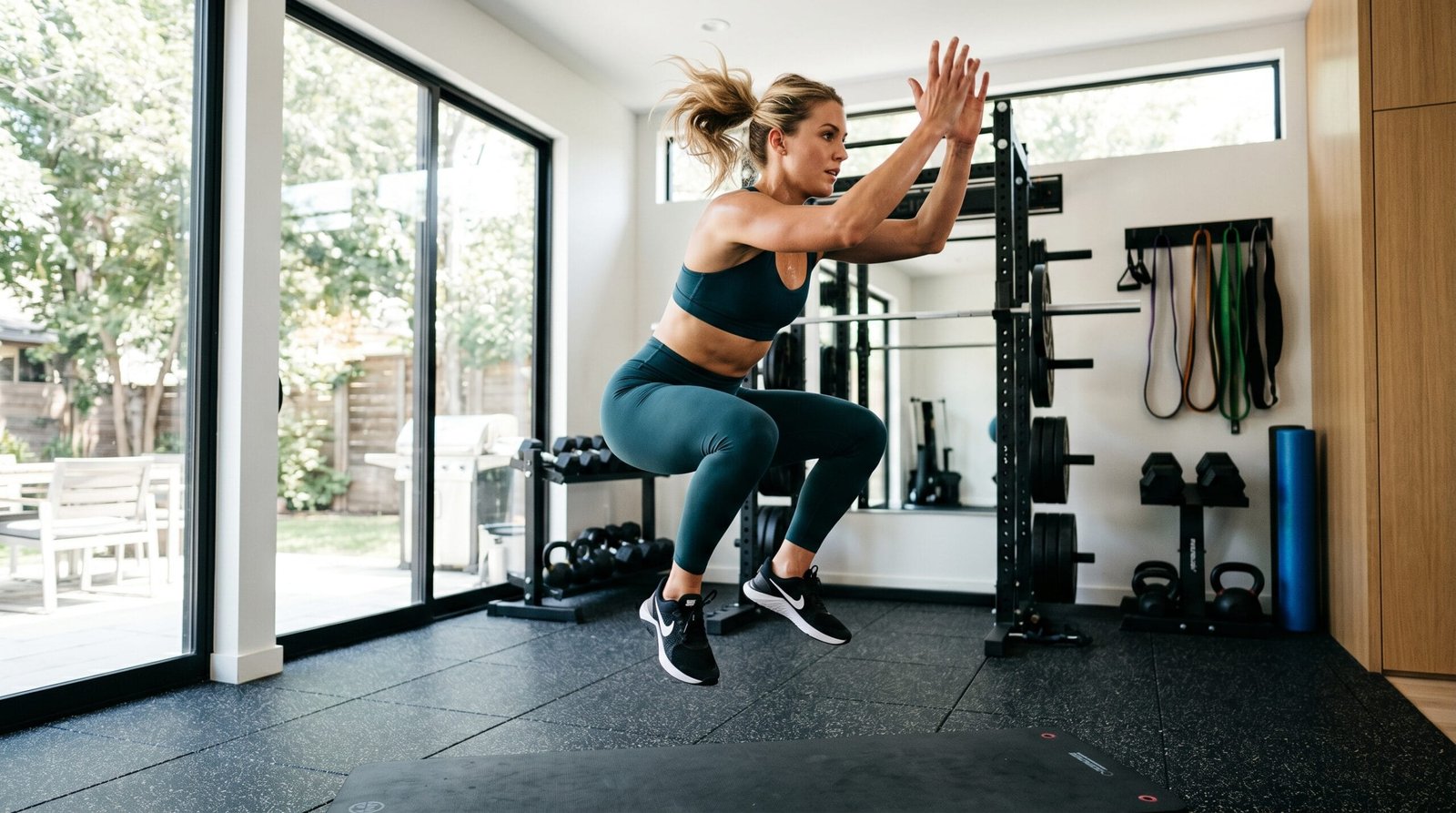
- Jump squats — explode up from a squat position, land softly
- Push-up to T rotation — push-up, then rotate into side plank
- Alternating reverse lunges — step back, knee hovers above floor
- Burpees — full range, chest to floor
- Mountain climbers — drive knees to chest rapidly in plank position
Cool-Down (5 minutes): Walk, pigeon pose, a few hip mobility exercises to release the hip flexors after all those lunges and jump squats, spinal twists
Advanced HIIT Workout (Tabata Format)
Duration: 30 minutes | Equipment: None (dumbbells optional) | Structure: 20 sec max effort / 10 sec rest × 8 rounds per exercise
Exercise 1 (4 minutes Tabata): Squat jumps — 8 rounds of 20/10
Rest 1 minute
Exercise 2 (4 minutes Tabata): Push-up variations — 8 rounds of 20/10
Rest 1 minute
Exercise 3 (4 minutes Tabata): Alternating lunge jumps — 8 rounds of 20/10
Rest 1 minute
Exercise 4 (4 minutes Tabata): Burpee tuck jumps — 8 rounds of 20/10
Rest 2 minutes
Finisher (5 minutes AMRAP): 10 mountain climbers + 10 squat jumps + 10 push-ups — as many rounds as possible
4-Week HIIT Program for Beginners
Follow this schedule to build from 2 sessions per week to a sustainable 3-session routine. Rest days are just as important as training days.
| Week | Sessions/Week | Work Time | Rest Time | Rounds | Total Time |
|---|---|---|---|---|---|
| Week 1 | 2 | 30 sec | 60 sec | 3 | ~18 min |
| Week 2 | 2 | 35 sec | 55 sec | 3 | ~19 min |
| Week 3 | 3 | 40 sec | 45 sec | 3–4 | ~22 min |
| Week 4 | 3 | 45 sec | 45 sec | 4 | ~25 min |
Sample weekly schedule (Week 3–4):
- Monday: HIIT workout (25 min)
- Tuesday: 30-minute walk or yoga
- Wednesday: HIIT workout (25 min)
- Thursday: Rest or light stretching
- Friday: HIIT workout (25 min)
- Saturday: Active recovery (hiking, swimming, easy cycling)
- Sunday: Full rest
Common HIIT Mistakes to Avoid
Skipping the Warm-Up
Going from cold muscles to maximum-effort jumps is a fast track to injury. Always spend 5 minutes gradually raising your heart rate and mobilizing the joints you’ll be using. This isn’t optional — it’s non-negotiable.
Not Working Hard Enough During Intervals
The most common mistake in HIIT is making it a moderate-intensity workout. If you can chat comfortably during your work intervals, you’re doing “interval training” — not HIIT. The intervals need to feel genuinely hard. Start conservatively on the first round, then push progressively harder.
Doing Too Much, Too Soon
Many beginners jump to daily HIIT inspired by transformation stories, then burn out or get injured within 2 weeks. Two sessions per week, with full recovery between them, produces better results than five sessions with inadequate recovery. Respect the rest days.
Neglecting Nutrition and Sleep
HIIT is a significant physiological stressor. Without adequate protein (to repair muscle) and sleep (to restore the nervous system), you’ll plateau quickly. Aim for 0.7–1g of protein per pound of bodyweight and 7–9 hours of sleep on training days.
HIIT for Weight Loss: What to Expect
HIIT is highly effective for fat loss, but realistic expectations matter. Here’s what the research shows:
- Weeks 1–2: Increased energy, improved sleep, DOMS (muscle soreness). Scale may not move yet — don’t panic.
- Weeks 3–4: Cardiovascular fitness noticeably improves. You’ll complete the same workout with less effort. Body composition begins shifting.
- Weeks 6–8: Fat loss becomes visible, especially around the midsection. Most studies show 1–2% body fat reduction with consistent HIIT over 8 weeks.
- Weeks 8–12: Significant body recomposition is possible — more muscle definition, reduced waist circumference, improved metabolic markers.
Important: HIIT is most effective for fat loss when combined with a balanced, protein-rich diet. You cannot out-train a poor diet — but HIIT is a powerful accelerator when paired with good nutrition.
Frequently Asked Questions
How long should a HIIT workout be?
Effective HIIT workouts range from 15–30 minutes of actual training (excluding warm-up and cool-down). Longer is not better — after 30 minutes, you’re typically no longer working at HIIT intensity. If you’re doing 45-minute “HIIT” sessions, it’s more likely moderate-intensity interval training, which has its own benefits but isn’t the same thing.
Can beginners do HIIT?
Yes, with modifications. Beginners should start with low-impact exercises (no jumping), longer rest periods (60 sec rest for every 30 sec work), and just 2 sessions per week. Walking lunges, bodyweight squats, and modified push-ups can all be done HIIT-style without the impact of jumping exercises. Build the habit and base fitness first, then add intensity over weeks 3–4.
Is HIIT good for losing belly fat?
Yes — HIIT is particularly effective at reducing visceral (deep abdominal) fat. A 2017 systematic review found that HIIT produced significantly greater reductions in abdominal fat than moderate-intensity continuous exercise, even when total exercise volume was matched. This is partly due to the hormonal effects of high-intensity effort — particularly growth hormone release, which specifically targets fat mobilization.
How many calories does HIIT burn?
A 20-minute HIIT session burns approximately 200–400 calories during the workout itself, depending on bodyweight, fitness level, and workout intensity. With the afterburn effect adding 50–150 additional calories over 24 hours, total caloric cost can reach 250–550 calories per session — comparable to a 40–60 minute moderate jog, in half the time.
Should I do HIIT on an empty stomach?
This is individual. Some people perform well fasted; others feel dizzy and weak without food. If you train in the morning, a small snack 30–60 minutes before (banana, handful of nuts, protein shake) is typically sufficient. Avoid heavy meals within 2 hours of HIIT. Hydrate well before any session — even mild dehydration measurably reduces performance.
The Bottom Line
HIIT is one of the most scientifically validated forms of exercise for fat loss, cardiovascular fitness, and metabolic health — and it delivers results in a fraction of the time of traditional cardio. The key is respecting the intensity requirements (you need to actually push hard), managing recovery (2–3 sessions per week is enough), and building progressively.
Start with the beginner workout above twice this week. Focus on effort during the work intervals, full recovery between them, and consistent sleep and protein intake outside the gym. Four weeks of that formula will transform your fitness — and how you feel every day.
⚕️ Disclaimer: This article is for general informational and educational purposes only and is not a substitute for professional medical advice, diagnosis, or treatment. Always consult a qualified healthcare provider before making changes to your diet, exercise, supplement, or wellness routine. Read our full medical disclaimer.



[…] phase: Often the best few days for peak-effort work — your heaviest lifts, a HIIT session, or a personal-best attempt, if that’s part of your […]
[…] that work the same muscles. If you’re also doing cardio — like the beginner circuit in my HIIT workout guide — try to put it on a different day than strength training, or after it, not […]