

Hi, I’m Sophia. If a long exhale has ever taken the edge off a stressful moment, you’ve already felt your vagus nerve at work. It gets little attention in talk about stress, and you can work with it using a few simple vagus nerve exercises. No equipment, no big time commitment.
Below: what the vagus nerve does, seven exercises to try at home, and a five-minute vagus nerve reset for the days you feel wound up.
What the Vagus Nerve Does
The vagus nerve is the main nerve of your parasympathetic nervous system, the “rest and digest” branch that balances out your sympathetic “fight or flight” response. According to Cleveland Clinic, your left and right vagus nerves carry about 75% of your parasympathetic nervous system’s nerve fibers, running from your brainstem down through your neck, chest and abdomen to help regulate heart rate, breathing, digestion and mood. It’s the longest cranial nerve in the body, which is part of why breathing, movement, sound and touch can all influence it.
When people talk about “vagal tone,” they’re referring to how readily your vagus nerve can shift your body out of a stressed state and back toward calm. Vagal tone is often discussed alongside stress resilience, and one accessible window into it is heart rate variability (HRV), the tiny fluctuations in timing between heartbeats. Harvard Health notes that HRV reflects the push-pull between your sympathetic and parasympathetic systems, and that regular exercise, meditation, stress reduction and better sleep are among the factors that tend to raise it over time. The same article adds that there’s no set definition of a “high” or “low” HRV and no professional guidelines for it, so treat it as a rough window rather than a score to chase.
A note on scope: these are everyday self-regulation tools. They don’t treat a diagnosed vagus nerve disorder, and they’re different from clinical vagus nerve stimulation (VNS), which uses an implanted medical device under a doctor’s care.
What a “Vagus Nerve Reset” Means
You’ll see the phrase “vagus nerve reset” everywhere online, and it can sound more dramatic than it is. Cleveland Clinic describes a vagus nerve reset as using techniques that soothe your vagus nerve so your body can shift out of fight-or-flight mode and toward rest and recovery. In plain terms, it’s a short, deliberate practice that tells your body it’s safe to downshift. One session won’t erase a stressful season. Done regularly, it can become a tool you rely on.
Where to Start
If your stress lives mostly in your body (a clenched jaw, tight shoulders, a knotted stomach), start with our somatic exercises for stress. If you want one counted breathing pattern, try box breathing. This post covers the wider toolkit: seven exercises built on breath, temperature, sound, touch and movement, so you can pick whatever suits the moment. If you’ve wondered how to stimulate the vagus nerve without a device, these are the simple, low-risk places to begin.
7 Vagus Nerve Exercises to Try
1. Extended-Exhale Breathing: A Simple Vagus Nerve Reset
Cleveland Clinic neurologist Dr. Emad Estemalik explains that when you exhale longer than you inhale, it signals to your vagus nerve that you’re not in danger, allowing it to relax (Cleveland Clinic). Try inhaling for four seconds and exhaling for six. A minute or two of this pattern is often enough to notice your shoulders drop.
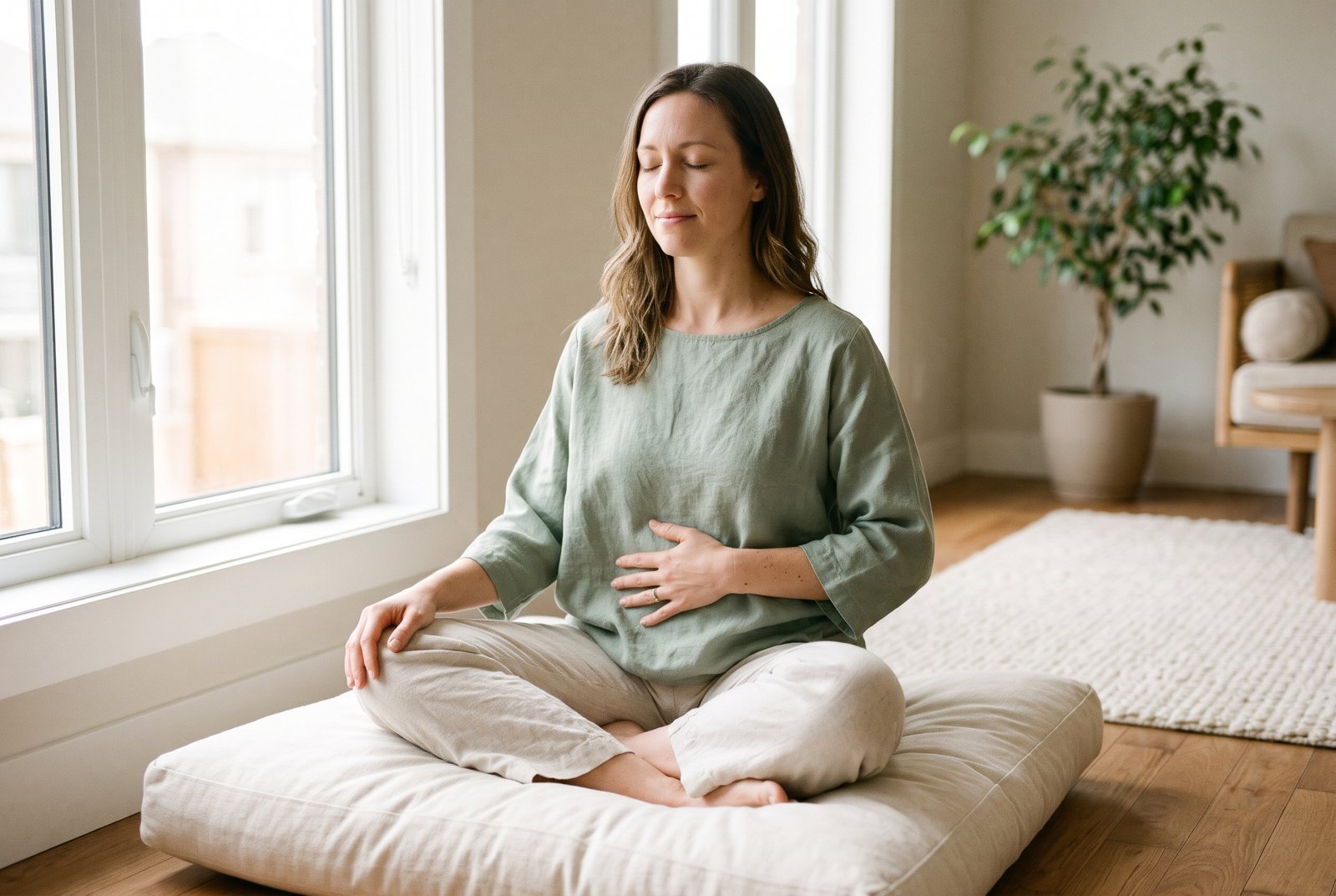
If six seconds feels like a stretch, go with a three-second inhale and a five-second exhale instead. The ratio matters more than the exact numbers, and you should never feel air-hungry or strained. Breathe through your nose if that’s comfortable, and let the exhale feel like a slow, quiet sigh.
2. Diaphragmatic (Belly) Breathing
Slow belly breathing is one of the most studied relaxation techniques. NCCIH notes that studies suggest slow, deep (diaphragmatic) breathing may modestly lower blood pressure and cortisol, and that evidence it may help reduce stress is preliminary. Place a hand on your abdomen and breathe so that your hand rises on the inhale, keeping your chest relatively still. If you want a more structured pattern to follow, our guide to box breathing walks through a simple 4-4-4-4 count that works well here.
3. Cold Exposure: A Quick Vagus Nerve Reset
Cold-water immersion has become popular as a mental reset, and Cleveland Clinic includes cold exposure among its at-home techniques. The evidence is less settled than the buzz suggests, though: Harvard Health says proof for the purported benefits is shaky, and the initial shock of cold water can trigger the “fight or flight” response before any calming effect. You don’t need an ice bath. Cleveland Clinic suggests splashing cold water on your face, holding an ice pack to your neck, or taking a brief cold shower as accessible starting points (Cleveland Clinic). Those strategies may help slow your heart rate and help you feel more centered.
Start with the gentlest option, a cold splash on your face, and see how your body responds. Cold exposure is the one practice on this list worth introducing gradually, and it’s the one that most deserves a conversation with your provider first if you have any heart or blood pressure concerns. Both Harvard Health and Cleveland Clinic advise against cold exposure, or checking with a doctor first, for people with heart disease or heart rhythm problems (more on that below).
4. Humming, Chanting, Singing or Gargling
Your vagus nerve passes close to your throat and inner ear, which may explain why sound and vibration can influence how you feel. Try humming a low, steady note for 30 seconds, chanting a drawn-out “om,” or simply singing along to something with a slow, steady rhythm. Cleveland Clinic also suggests listening to calming music with low, steady rhythms.
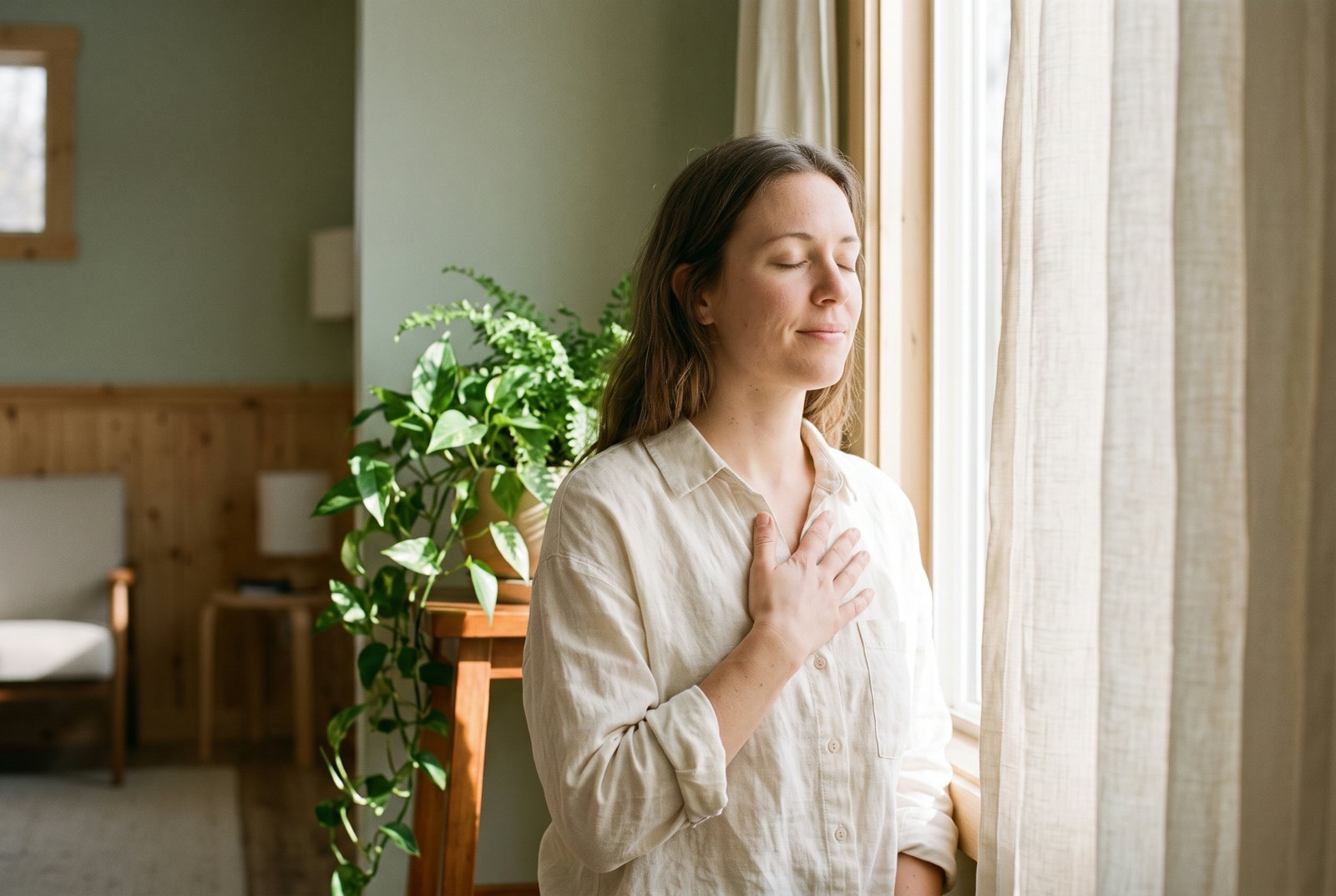
Some people also like a firm 30-second gargle with water as a quick, silly-feeling reset between tasks. The evidence behind gargling is thinner than for humming and slow breathing, so treat it as an optional extra. If it makes you laugh, that helps too.
5. Foot, Neck or Ear Massage
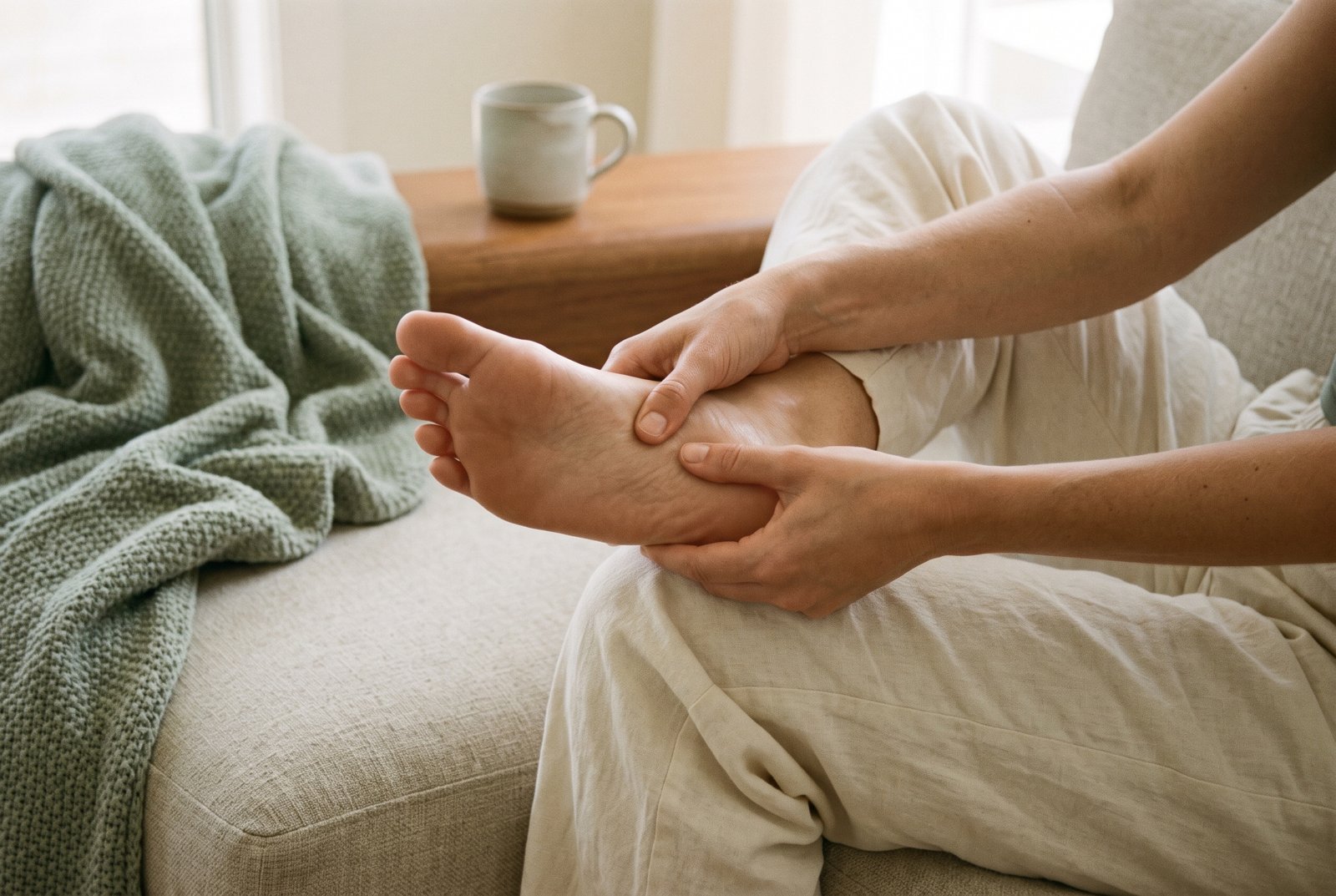
Certain types of touch, especially around the feet, neck or ears, may help calm the nervous system, and you can do it yourself. Try gently rotating your ankle, then using your thumbs to press slowly along the arch of your foot for a minute or two on each side. You can also lightly pull and stretch each toe (Cleveland Clinic).
6. Moderate Aerobic Movement
Regular exercise is one of the factors Harvard Health says tends to increase HRV, and a gentle pace is a fine place to start. Walking, swimming or easy cycling all work, and pairing movement with the walking-based body awareness described in our somatic exercises for stress guide can make it more effective.
Start with a 15-to-20-minute walk at a pace that still lets you talk. For a few minutes, match a slightly longer exhale to your footsteps. That combines two of these practices in one. If you’d rather stay on the floor, our restorative yoga poses are a slower option. And if sitting all day leaves your hips stiff, a few hip mobility exercises make an easy warm-up before your walk.
7. Meditation, Mindfulness or Slow Yoga
Pairing breathwork with mindfulness, meditation or gentle yoga may add to the calming effect of any single technique on its own (Cleveland Clinic suggests the same pairing). If you’re not sure where to start, our beginner’s guided meditation script is a low-pressure entry point, especially in the evening. Our guide to mindfulness for stress reduction covers the basics.
A 5-Minute Vagus Nerve Reset Routine
When you’re short on time and need something simple, here’s one way to combine the exercises above into a single five-minute vagus nerve reset. Do it sitting or lying down, somewhere you can be undisturbed.
- Belly breathing (1 minute). One hand on your abdomen. Let the breath settle.
- Extended exhale (2 minutes). Inhale for four, exhale for six. If your mind wanders, bring it back to the count.
- Humming (30 seconds). On your next few exhales, hum a low, steady note and notice the vibration in your chest and throat.
- Foot or neck massage (1 minute). Press slowly along one arch, or use your fingertips to gently massage the back of your neck.
- Check in (30 seconds). Notice your shoulders, jaw and breath. You don’t need to feel “fixed.” A little softer than when you started is enough.
On a busy workday, the two-minute version (extended exhale plus humming) is often all you need. In the evening, pair the routine with dim lights and put your phone in another room. For more bedtime ideas, see how to fall asleep fast.
How Often to Practice
These exercises tend to work best as a regular habit, and they still help in an acute moment of stress. Picking one or two that fit naturally into your day (an extended-exhale break at your desk, a cold rinse at the end of your shower) is more likely to stick than trying all seven at once. Give any single practice a couple of weeks of consistency before deciding whether it’s working for you.
What the Evidence Does (and Doesn’t) Say
A lot of online content makes big promises about vagus nerve exercises, and the research hasn’t caught up. Slow breathing has the most research behind it: a 2022 meta-analysis found that slow breathing increased vagally mediated heart rate variability, and a 2024 review found short-term effects on HRV and blood pressure but only a modest effect on negative emotion. For gentle movement and mindfulness the support is more general. Harvard Health, for instance, points to exercise, meditation and better sleep as factors that tend to raise HRV, and NCCIH describes the evidence for relaxation approaches like these as preliminary. But Cleveland Clinic also notes that some of the more specific ideas, like a possible role for an overstimulated vagus nerve in long COVID symptoms, are still early research that needs further testing. Treat these practices as low-cost ways to support your stress response, not as cures. If stress has been building for months, our guide to chronic stress effects on health explains what it can do to the body, and the gut-brain connection and anxiety covers another route the vagus nerve is involved in.
When to Be Cautious
Most of these techniques are low-risk for generally healthy people, but Cleveland Clinic recommends checking with your provider first if you have a heart condition or irregular heartbeat, take medications that affect your nervous system, have a history of fainting or low blood pressure, or are pregnant (Cleveland Clinic). Cold exposure in particular is worth introducing gradually rather than starting with anything extreme. And if you’re managing persistent anxiety, digestive symptoms, or an irregular heart rhythm, these exercises are a helpful complement to care, not a substitute for seeing a healthcare provider about the underlying cause.
If tension shows up more in your body than in racing thoughts, our breathing exercises for anxiety guide covers six techniques for different situations, and if you’re dealing with the broader toll of chronic stress on sleep and cortisol, we go deeper in how to lower cortisol naturally.
When to See a Doctor
Stop any exercise and get medical help right away if you feel faint, dizzy, short of breath, or have chest pain or a racing or irregular heartbeat. Make an appointment with a healthcare provider if you notice any of the following:
- Fainting spells, frequent dizziness or lightheadedness
- Palpitations or a heartbeat that feels irregular
- Anxiety, low mood or stress that is interfering with work, relationships, or sleep for more than a couple of weeks
- Ongoing digestive symptoms such as persistent nausea, bloating or changes in bowel habits
- Symptoms that get worse, rather than better, when you practice these techniques
If you’re ever having thoughts of harming yourself, please don’t wait. In the U.S., you can call or text 988 to reach the Suicide & Crisis Lifeline at any time.
A Note on Ashwagandha (Supplements Aren’t a Substitute)
The exercises above do the main work, and no supplement replaces them. If daily stress still makes it hard to feel settled, you could ask your doctor whether an adaptogen like Attain’s Organic Ashwagandha Root Capsules with Black Pepper ($24.99) makes sense to use alongside these exercises. Disclosure: Attain Supplements is our own brand, so we earn from purchases made through this link. NCCIH says some ashwagandha preparations may help with stress and sleep, though many of the studies are small and use different preparations. Talk with your doctor before trying it. NCCIH advises avoiding ashwagandha during pregnancy and breastfeeding and cautions that it may not suit people with thyroid or autoimmune conditions or those who take certain medications.
Vagus Nerve Exercises: Frequently Asked Questions
What is a vagus nerve reset?
It’s a short practice, typically slow breathing, a cold splash, humming, gentle touch or movement, meant to help your body shift out of fight-or-flight mode and into a calmer, more balanced state. Cleveland Clinic uses the term for at-home techniques that promote stress relief.
Do vagus nerve exercises really work?
Many people find slow breathing, gentle movement and mindfulness calming, and there’s a plausible physiological reason for it. Slow breathing has the most research support. Research on some of the more specific claims is still developing, so think of these as stress-management habits, not guaranteed fixes.
Do I have to use cold exposure?
No. Breathing, humming, massage and walking are all gentler options, and it’s perfectly fine to skip cold exposure, especially if you have heart or blood pressure concerns.
Can these exercises help me sleep?
Cleveland Clinic lists better sleep among the things a vagus nerve reset may help. Slow breathing and a calming wind-down routine are a low-risk way to try it, but if you have persistent trouble sleeping, talk with a healthcare provider.
How is this different from vagus nerve stimulation (VNS)?
VNS is a medical treatment using an implanted device, prescribed and monitored by a doctor for specific conditions. The exercises here are everyday self-care habits and are not a substitute for that treatment.
The Bottom Line
A longer exhale, a hum, a slow walk or a cold splash won’t fix a stressful month. Practiced regularly, they can help you feel calmer day to day. Pick the easiest one and try it today.
Want more nervous-system and stress-management guidance like this? Join the newsletter for new guides as soon as they’re published.
Sources
- Cleveland Clinic: Vagus Nerve
- Cleveland Clinic: Vagus Nerve Reset
- Harvard Health: How relevant is heart rate variability?
- Harvard Health: Cold plunges: Healthy or harmful for your heart?
- Cleveland Clinic: Are Cold Showers Good for You?
- Neuroscience & Biobehavioral Reviews (2022): Effects of voluntary slow breathing on heart rate and heart rate variability: a systematic review and meta-analysis
- Mindfulness (2024): The Effect of Slow-Paced Breathing on Cardiovascular and Emotion Functions: A Meta-Analysis and Systematic Review
- NIH NCCIH: Stress
- NIH NCCIH: Ashwagandha
⚕️ Disclaimer: This article is for general education and isn’t medical advice. Talk with a doctor or other qualified healthcare professional about your own health, especially if you’re pregnant, nursing, taking medication, or managing a condition, and before starting a supplement or new routine. Read our full medical disclaimer.


Leave a Reply