
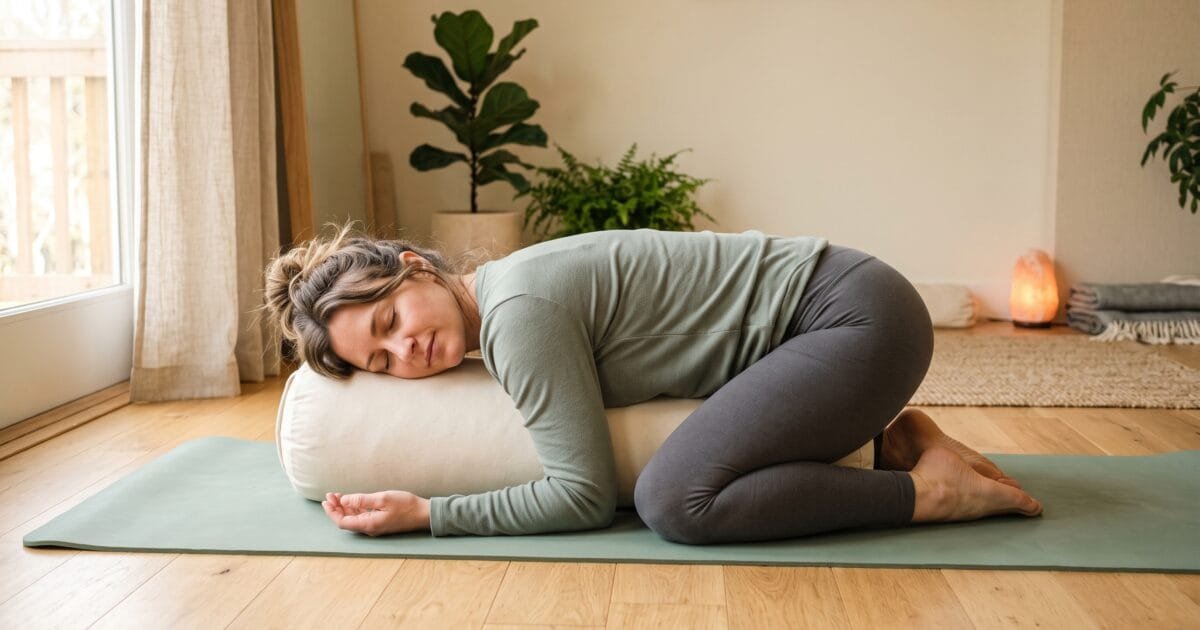
Hi, I’m Sophia. If your idea of yoga is sun salutations and a sweaty flow, restorative yoga is going to feel like a completely different practice — because it is. There’s no strength-building, no flowing between poses, and honestly, not much “yoga-ing” happening at all once you’re set up. You get into a supported shape, usually with a pillow or rolled blanket doing most of the work, and then you just stay there for several minutes while your body does the rest.
It sounds almost too simple to matter. But on a day when your nervous system has been running hot — work stress, a bad night’s sleep, a body that just won’t settle — this kind of stillness can do something a faster practice can’t. Below are 8 poses I come back to often, how to set them up with things you likely already own, and how to tell when restorative yoga is the right tool versus when you need something more active.
What Makes Restorative Yoga Different
Most yoga styles ask your muscles to work — holding a plank, moving through a flow, building heat. Restorative yoga does the opposite: props (bolsters, blankets, blocks, or pillows) take over the work of holding you up, so your muscles can fully let go. Poses are held much longer than in a typical class, usually 5 to 10 minutes instead of a few breaths, which gives your body time to actually register that it’s safe to relax rather than just briefly pausing before the next pose.
That combination — full physical support plus extended stillness — is associated with a shift toward parasympathetic (“rest and digest”) nervous system activity, the same general shift I’ve written about with slow breathing practices like box breathing. The two pair naturally: restorative yoga gives your body a supported shape to relax into, while a slow breath pattern gives your mind something steady to follow while you’re there.
What You’ll Need
You don’t need a studio prop closet to do this at home. A few firm pillows, a rolled-up blanket or towel, and a wall will get you through every pose below:
- Bolster substitute: a firm pillow, rolled beach towel, or two-three regular pillows stacked and rolled
- Blocks: stacked hardcover books work fine
- Blankets: for padding under knees or draped over you for warmth — your body temperature tends to drop as you relax
- A wall: for the legs-up-the-wall pose
- Optional: an eye pillow or folded washcloth over the eyes, which some people find helps them settle faster
8 Restorative Poses to Try
You don’t need to do all 8 in one sitting — even 2 or 3 poses held well is a complete practice. Aim for 5–10 minutes per pose, and come out of each one slowly. If your hips feel especially tight going in — common after a day of sitting — a couple of gentle hip mobility exercises beforehand can make the hip-opening poses below settle more easily.
- Supported Child’s Pose (Balasana) — Kneel with knees wide, big toes touching, and fold forward over a bolster or stacked pillows placed lengthwise between your thighs. Turn your head to one side (switch halfway through) or rest your forehead on stacked hands. This one’s a good starting pose since it’s low-risk and immediately grounding.
- Legs-Up-the-Wall (Viparita Karani) — Sit sideways against a wall, then swing your legs up as you lie back, scooting your hips as close to the wall as is comfortable. Arms rest open at your sides, palms up. This gentle inversion is a favorite for tired, achy legs after a long day on your feet, and many people find it quietly calming for the mind too.
- Reclined Bound Angle Pose (Supta Baddha Konasana) — Lie back over a bolster placed along your spine, bring the soles of your feet together, and let your knees fall open, supported by a block or pillow under each thigh so nothing feels strained in the hips or groin. Opens the chest and hips at the same time.
- Supported Fish Pose — Place a bolster or rolled blanket horizontally under your shoulder blades so your chest lifts and your head tips gently back (support your head with a folded blanket if your neck needs it). This counters the forward-hunched posture many of us hold all day at a desk.
- Supported Seated Forward Fold — Sit with legs extended (knees softly bent if your hamstrings are tight), and fold forward over a bolster or stack of pillows resting on your thighs. Let your whole upper body go heavy into the support rather than reaching for your toes.
- Supported Reclining Twist — Lying on your back, let both knees fall to one side, supported underneath by a block or pillow so your lower back doesn’t have to hold the position. Arms open in a T-shape, gaze turned gently the opposite way from your knees. Switch sides halfway through your hold.
- Supported Bridge Pose — Lie on your back, feet flat, and lift your hips just enough to slide a block (on its lowest or middle height) under your sacrum — the flat triangular bone at the base of your spine, not your lower back itself. Let your hips fully release onto the block. A gentle way to open the front of the hips and chest without any muscular effort.
- Savasana (Final Rest) — Lie flat, arms and legs relaxed and slightly apart, and simply stay. A folded blanket over your body and a small pillow under your knees can make this far more comfortable than it sounds. This is the pose most people are tempted to skip and the one that matters most — give it at least 5 minutes. If you find yourself wanting to stay in this state longer, a full yoga nidra practice is essentially an extended, guided version of Savasana.
Building a Simple Session
A full restorative practice might look like: Supported Child’s Pose (5 min) → Reclined Bound Angle (7 min) → Supported Bridge (5 min) → Legs-Up-the-Wall (7 min) → Savasana (10 min). That’s under 35 minutes, but even a single pose held for 10 quiet minutes before bed is a real practice, not a lesser version of one. Breathe slowly and naturally throughout — you don’t need a specific pattern, though pairing a held pose with a few rounds of box breathing or another slow-breath technique at the start can help you settle in faster.
When Restorative Yoga Helps Most
This isn’t the right tool for every day — but it’s an especially good fit for:
- High-stress days when your body feels wired but you’re too depleted for a workout — this is a genuine way to recover, not just a way to relax.
- Trouble winding down at night, alongside the habits in my guide to falling asleep fast.
- Perimenopause and menopause, when hot flashes, sleep disruption, or general nervous-system overwhelm make a vigorous practice feel like one more demand rather than relief — see my perimenopause symptoms guide and my dedicated guide to yoga for perimenopause and menopause for more on this stretch of the hormonal transition.
- Recovering from illness, travel, or a demanding week, when your body needs rest more than it needs to be challenged.
On the other hand, if you’re looking to build strength, improve mobility, or work through restlessness that a slower pace tends to amplify rather than settle, a more active practice — or a walk — is probably the better call that day. Restorative yoga is recovery, not a replacement for movement you also need.
Who Should Be Cautious
- If you’re pregnant, skip poses that involve lying flat on your back for extended periods past the first trimester (Supported Bridge and Savasana can both be modified with extra elevation under the torso — a prenatal yoga resource or your provider can guide specifics).
- If you have a recent or unhealed injury, particularly to the knees, hips, or spine, check with a doctor or physical therapist before deep hip-opening poses like Reclined Bound Angle.
- Long, passive holds can occasionally bring up strong emotions as the body releases tension — that’s a normal response, not a sign anything is wrong, but it’s worth knowing about going in.
- None of this should cause sharp pain. Gentle stretch sensation is fine; pain means back off the depth of the pose or skip it.
A Simple Way to Start
You don’t need a full hour or a stack of specialty props to feel the difference. Tonight, try just one pose — Legs-Up-the-Wall or Supported Child’s Pose are the easiest entry points — and give it 8 quiet minutes before you decide whether it’s for you.
I’m slowly building out a full library of practice-based guides like this one — breathwork, gentle movement, and mindfulness tools you can actually fit into a real week. If that’s useful, subscribing to the newsletter is the easiest way to hear about new guides as soon as they’re published.
If stress is also showing up as tension you can feel in your body even after a practice like this, some readers find Attain’s Ashwagandha Root Capsules ($24.99) a helpful complement — ashwagandha is a well-studied adaptogen often used to support the body’s stress response over time. It’s not a substitute for rest or a practice like this one, and it’s worth checking with your doctor if you’re pregnant, nursing, or on thyroid or sedative medication. Disclosure: Attain Supplements is part of our family of brands, so we may earn from purchases made through this link.
⚕️ Disclaimer: This article is for general informational and educational purposes only and is not a substitute for professional medical advice, diagnosis, or treatment. If you are pregnant or have a recent injury, chronic pain condition, or cardiovascular concern, consult a qualified healthcare provider before beginning a new yoga practice. Read our full medical disclaimer.
Related Reading
- The 4 Best Yoga Mats to Help Even the Most Unbothered Yogis
- 5 Easy Yoga Poses to Enhance Your Mental and Physical Well-being
- Hip Mobility Exercises: 8 Moves to Undo a Day of Sitting
- Pilates for Beginners at Home: A Realistic Starting Guide (coming soon)


[…] whether it’s a brisk walk, a restorative yoga session, or a tough workout, physical exercise is key to boosting our mental acuity. It helps us reach our […]
[…] system. If sitting still and counting breaths isn’t the thing that helps on a given day, restorative yoga works the same nervous-system pathway through long, supported holds instead, and a guided […]