
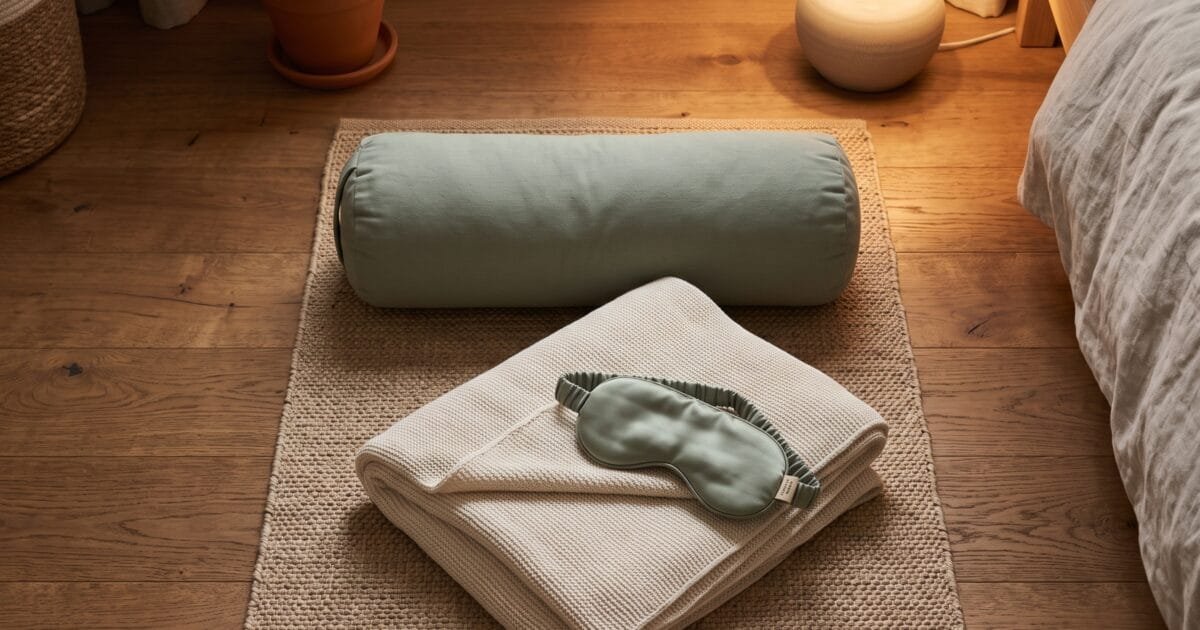
Some nights, the problem isn’t falling asleep faster. You need to rest, and your mind won’t stop listing tomorrow’s tasks the second your head hits the pillow. That’s where yoga nidra for sleep can help.
Yoga nidra (literally “yogic sleep”) guides your body into deep, conscious relaxation while you stay lightly aware. Falling asleep isn’t the goal, though at bedtime it often happens. There are no poses and no flexibility required. You lie down and follow a voice.
Below are the basic steps and an original 20-minute yoga nidra script you can read aloud or record for yourself.
What Is Yoga Nidra?
According to Cleveland Clinic, yoga nidra is distinct from seated meditation: with meditation, you’re sitting upright in a waking state, focusing the mind while thoughts come and go. With yoga nidra, you’re lying down, moving through a structured, guided sequence toward what practitioners call a state of “conscious awareness sleep”: deeply relaxed, but not asleep.
Yoga therapist Judi Bar, quoted by Cleveland Clinic, explains that, in her view, the practice works with the autonomic nervous system: it helps calm the sympathetic (“fight-or-flight”) branch and activate the parasympathetic (“rest-and-digest”) branch. She also describes the pineal gland releasing melatonin, the hormone most associated with sleep timing, in that deeper relaxed state. That’s a practitioner’s explanation, not something shown in sleep trials, but it’s one idea about why a nighttime practice might make it easier to drift off afterward.
Cleveland Clinic also cites a study in which both meditation and yoga nidra reduced anxiety and stress, with yoga nidra seeming more effective for anxiety; the study also suggested it may help with both the cognitive and physical symptoms of anxiety, meaning the racing thoughts and the physical tension that often show up together. That’s a single study summarized secondhand, so read it as promising rather than settled.
Why It Helps When Sleep Won’t Come
The broader research on meditation and mindfulness-based practices offers some context, though it isn’t about yoga nidra specifically. The National Center for Complementary and Integrative Health (NCCIH) summarizes a 2019 analysis of 18 studies that found mindfulness meditation practices improved sleep quality more than education-based treatments, with effects no different from evidence-based approaches like cognitive behavioral therapy and exercise. NCCIH also notes that much of the research on these topics has been preliminary. Sleep is also one of the top reasons people take up mindfulness in the first place. NCCIH’s review notes that a desire for better sleep was cited in more than half of survey responses from people who practice mindfulness meditation.
None of this makes yoga nidra a proven treatment for chronic insomnia, and persistent or severe sleep problems need a doctor’s input (more on that below). As a low-effort, no-equipment way to downshift before bed, it’s a gentle tool to keep on hand. If a wired body is the main problem, a few minutes of box breathing beforehand can help you settle.
How to Try Yoga Nidra Tonight
You don’t need an app, a class, or any equipment to start, though a recorded guided practice (there are free ones on YouTube and most meditation apps) makes the first few tries much easier than winging it alone. Here’s a simplified version of the sequence Cleveland Clinic outlines, adapted from yoga teacher Richard Miller’s classic 10-stage framework:
- Get set up. Lie on your back on a bed, mat, or recliner. Support your knees and lower back with a pillow or bolster if that’s more comfortable. Cover up with a blanket, since Cleveland Clinic notes that your body temperature drops as you relax.
- Set an intention. Silently name why you’re doing this practice right now. Something as simple as “I want to feel calmer” is enough.
- Find a felt sense of safety. Notice a place in your body, or a memory, that feels steady and secure. Rest your attention there for a moment.
- Body scan. Slowly move your attention through each part of your body, from your toes to the crown of your head, noticing sensation without trying to change anything.
- Follow your breath. Watch the air move in and out through your nose, and notice your belly rise and fall, without controlling the pace.
- Let feelings surface. If tension or emotion from the day comes up, let it be there rather than pushing it away.
- Observe your thoughts. Watch thoughts pass without following them or judging them.
- Rest in the stillness. Stay in that quiet, spacious state for a few minutes.
- Reflect. Before you finish, notice how your body feels compared to when you started.
- Transition slowly. Wiggle your fingers and toes, and give yourself a minute before getting up. If it’s bedtime, let yourself drift into sleep from here.
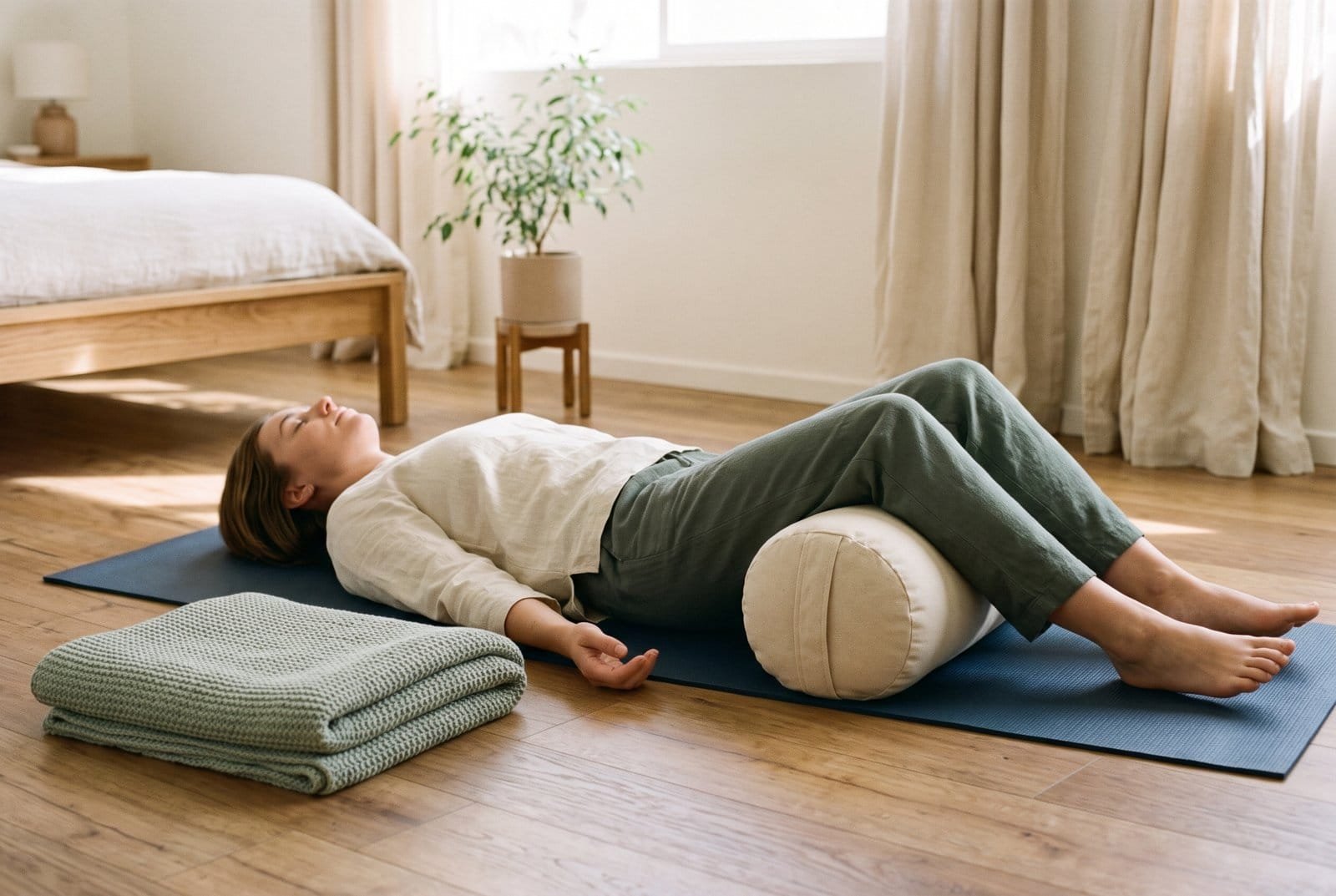
Start with a 15–20 minute session (the length Cleveland Clinic suggests) rather than a full 45-minute one, especially the first few times. If your mind wanders constantly and you feel “bad” at it, that’s normal. The practice can still help even when it doesn’t feel like it.
A Simple 20-Minute Yoga Nidra Script for Sleep
Here’s an original script written for bedtime use. You can read it slowly into your phone’s voice recorder and play it back, ask someone to read it to you, or read it through once and follow the shape from memory. Speak softly, and leave long silences wherever you see a pause marker. The silence is part of the practice. Read at a pace that feels almost too slow; the whole thing should take about 20 minutes.
Part 1: Settle In (About 3 Minutes)
Make yourself comfortable on your back, with a pillow under your knees if that helps. Let your arms rest by your sides, palms open. Pull a blanket over you. There is nothing to do right now except listen.
Take a slow breath in through your nose… and let it go with a long sigh. [pause 10 seconds] Once more… breathe in… and sigh it out. [pause 10 seconds]
Now let your breathing find its own rhythm. You don’t need to change it. Notice the places where your body meets the bed: your heels, your calves, your hips, your back, the back of your head. Let the bed hold your weight. [pause 15 seconds]
In your own words, silently set a gentle intention for tonight: “I’m allowed to rest.” Say it once, quietly, and let it go. [pause 10 seconds]
Part 2: Body Scan (About 8 Minutes)
Bring your attention to your right foot. Notice your toes… the sole… the heel… the ankle. Let this foot feel heavy and warm. [pause 10 seconds] Your right calf… your knee… your thigh… your hip. Let the whole leg sink. [pause 15 seconds]
Now your left foot… toes… sole… heel… ankle. Let it grow heavy. [pause 10 seconds] Your left calf… your knee… your thigh… your hip. The whole leg, sinking into the bed. [pause 15 seconds]
Notice your lower back, your belly, rising and falling on its own. [pause 10 seconds] Your chest… your upper back… the space between your shoulder blades. Let it widen and soften. [pause 15 seconds]
Bring your attention to your right hand… each finger… the palm… the wrist… the forearm… the elbow… the upper arm… the shoulder. Heavy and still. [pause 15 seconds] Now the left hand… each finger… the palm… the wrist… the forearm… the elbow… the upper arm… the shoulder. Heavy and still. [pause 15 seconds]
Your neck… your throat… your jaw. Let your teeth part slightly and your tongue rest. [pause 10 seconds] Your cheeks… your eyes, resting in their sockets… the space between your eyebrows… your forehead… your scalp. [pause 15 seconds]
Now feel your whole body at once, one heavy, quiet shape resting on the bed. [pause 30 seconds]
Part 3: Breath and Counting Down (About 5 Minutes)
Return your attention to your breath. Don’t change it. Just notice the cool air coming in, and the slightly warmer air going out. [pause 20 seconds]
We’ll count backward from twenty, one number for each out-breath. If you lose your place, that’s all right. Begin again at any number. Breathe in… and on the out-breath, think “twenty.” [pause] In… “nineteen.” [pause] In… “eighteen.” [pause]
(Continue counting down slowly, leaving a full breath between each number, until you reach one. If you drift off before then, the practice has done its job.)
Part 4: Rest and Imagery (About 2 Minutes)
Imagine a place where you feel completely safe. Maybe a quiet beach in the early evening, or a warm room with a window open. Notice what you can see there… what you can hear… the temperature of the air on your skin. [pause 30 seconds] Let the picture fade, and just rest in the stillness. [pause 60 seconds]
Part 5: Closing (About 2 Minutes)
If you’re still awake, repeat your intention silently: “I’m allowed to rest.” [pause 10 seconds]
Notice how your body feels now compared with when we began. [pause 20 seconds]
If you’d like to sleep, let yourself sleep. There’s nothing more to do. If you’d like to come back, start by deepening your breath, wiggling your fingers and toes, and rolling slowly onto your side. Take your time. Thank you for resting.
Tips for Using the Script
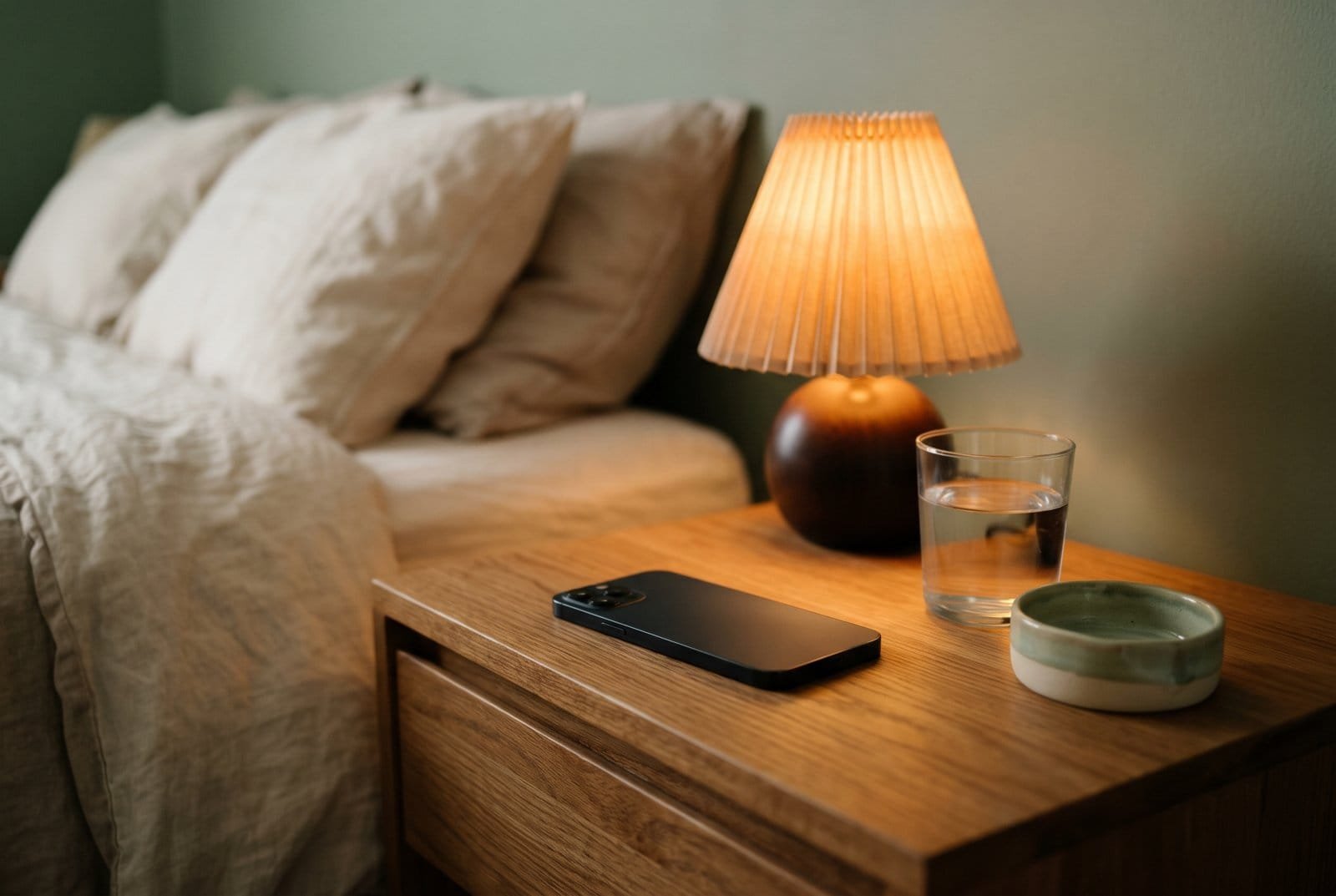
- Record it in your own voice. Many people find a familiar voice more soothing than a stranger’s. Keep the volume low, turn on “do not disturb,” and set the phone face down.
- Don’t try to stay awake. If you fall asleep partway through, that’s a perfectly good outcome at bedtime.
- Keep the room dim and cool, and use an eye mask if that helps.
- Be consistent. The practice tends to feel easier after a handful of tries, so give it a couple of weeks before deciding whether it works for you.
Who Should Be Cautious
Meditation and mindfulness practices are generally considered to carry few risks, but “few” isn’t the same as “none.” In a 2020 review of 83 studies, NCCIH reports that about 8 percent of participants had a negative effect from meditation, similar to the percentage reported for psychological therapies, with anxiety and depression the most commonly reported. That research is about meditation in general rather than yoga nidra specifically. If you have a trauma history, a diagnosed mental health condition, or you notice a guided relaxation practice consistently makes you feel worse rather than better, talk to a therapist or doctor about whether this tool is a good fit for you right now. If you’d like to keep exploring it, ask about working with an instructor trained in trauma-sensitive approaches.
When to See a Doctor
Occasional rough nights are part of life, but it’s worth talking to a healthcare provider if (the NHS advises seeing a GP if changing your sleep habits hasn’t helped, or if you’ve had trouble sleeping for months):
- Trouble falling or staying asleep happens most nights and has lasted several weeks
- You feel unrefreshed or very sleepy during the day despite spending enough time in bed
- You’ve been told you snore, gasp for air, or stop breathing during sleep
- Low mood, constant worry, or panic is a regular part of your evenings
- You’re relying on alcohol or sleep aids to get to sleep
A provider can look for underlying causes and discuss evidence-based treatment, including cognitive behavioral therapy for insomnia (which the NHS says is sometimes offered).
Pairing It With the Rest of Your Wind-Down
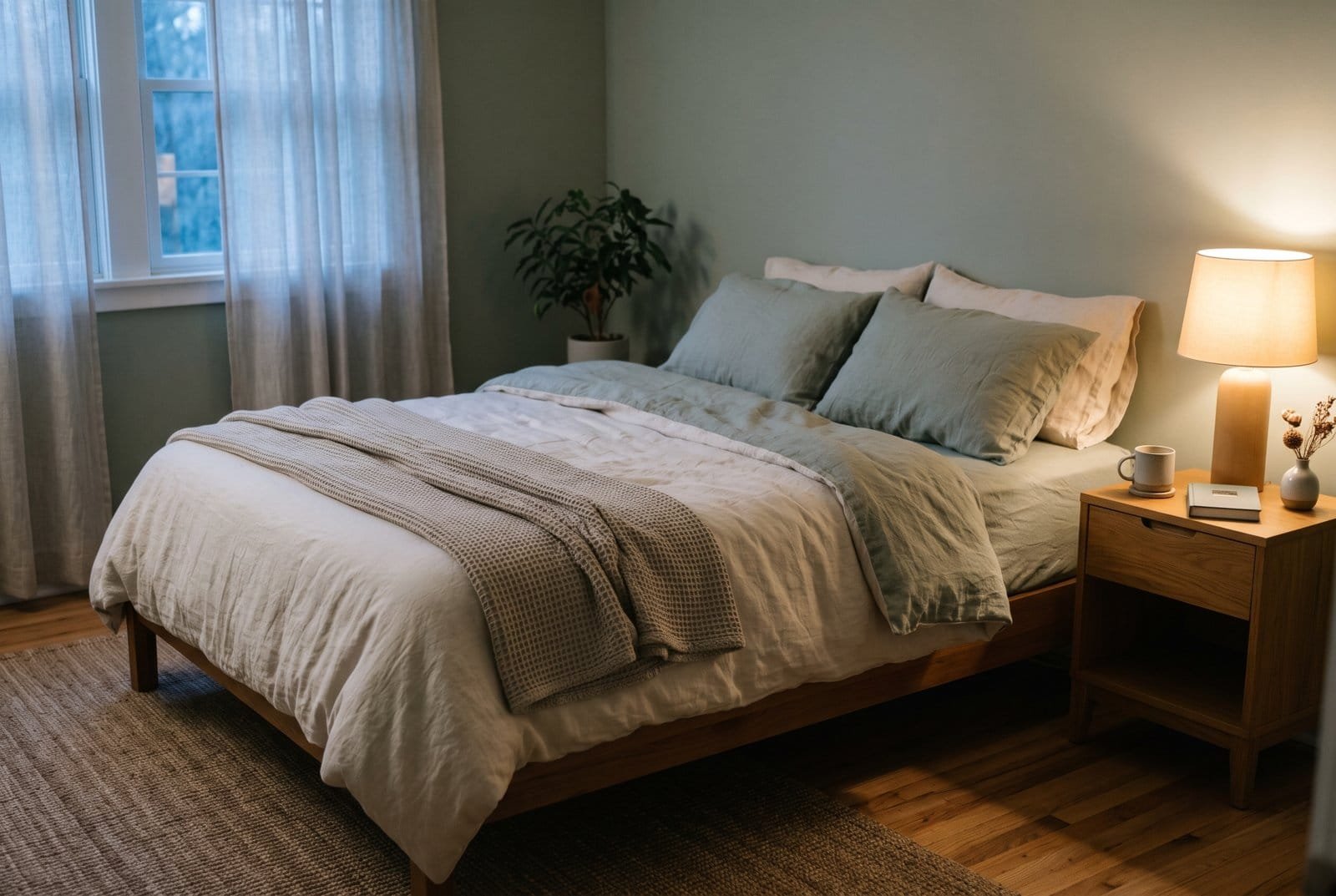
Yoga nidra may work best as one piece of a broader wind-down. If you’re already working on falling asleep faster with the basics (a cooler room, dimmer lights, a consistent bedtime), a short yoga nidra practice is a natural way to close out that routine. A steady sleep schedule helps too, and our guide to resetting your circadian rhythm explains how. If you’re curious about supplements, read our overview of magnesium for sleep and check with your doctor first. And if lying still and “doing nothing” feels harder than it sounds at first, easing in with something like restorative yoga a few nights a week can help your body get more comfortable with slowing down before you try a full guided practice. Somatic exercises for stress are another gentle way in.
If your mind is racing with worry rather than a to-do list, our guided meditation for anxiety script is a good companion to this one, and these breathing exercises for anxiety work in bed too. For more ways to calm your nervous system during the day, see our vagus nerve exercises. And if the trouble is waking in the early hours rather than falling asleep, our post on why you wake up at 3 a.m. covers common causes. You can also use a yoga nidra session on those nights. A few minutes of body scanning and slow breathing can help you settle back down without checking the clock.
Yoga Nidra for Sleep: Frequently Asked Questions
Is yoga nidra the same as taking a nap?
Not exactly. A nap involves actually falling asleep, while yoga nidra aims to keep you in a state of relaxed, conscious awareness, though Cleveland Clinic quotes a yoga therapist describing the brain moving toward the slower theta and delta states associated with sleep. Many people do drift off during a session, especially at night, and that’s fine. Your body decided it needed the sleep more than the practice.
How long should a yoga nidra practice be?
Sessions commonly range from 15 to 45 minutes. Cleveland Clinic recommends starting with 15 to 20 minutes and working up from there, rather than beginning with a long session.
Do I need a teacher or app to practice yoga nidra?
No, but most beginners find it easier to follow a recorded guided practice than to try to talk themselves through the stages solo. Free guided sessions are widely available through meditation apps and video platforms, and you can also use the script above.
Can yoga nidra replace treatment for insomnia?
No. It can be part of a wind-down routine, but persistent or severe sleep problems are worth discussing with a healthcare provider, who can look for underlying causes and recommend options such as cognitive behavioral therapy for insomnia.
Is it okay to fall asleep during yoga nidra?
Yes, especially when you practice at bedtime. If your goal is deep rest during the day, you may want to try it sitting in a reclined chair or earlier in the evening, but at night, falling asleep is a welcome result.
What if my mind keeps wandering?
That’s normal. Gently bring your attention back to the voice, your breath, or the part of the body being described, without scolding yourself. Returning your attention is the practice.
Can I record my own yoga nidra script?
Yes. Read the script above slowly into your phone’s voice recorder, leaving the pauses in. Many people find their own voice, or the voice of someone they trust, easier to relax into than a stranger’s. Play it back at low volume with “do not disturb” on.
The Bottom Line
Yoga nidra won’t fix chronic insomnia, but it’s an easy way to rest when your mind won’t switch off. Lie down, follow the script, and let sleep come if it wants to. Try it for a couple of weeks and see how your nights feel.
Want more evidence-based sleep and stress guidance like this? Join the newsletter for new guides as soon as they’re published.
Sources
- Cleveland Clinic: What Is Yoga Nidra?
- NIH NCCIH: Meditation and Mindfulness: Effectiveness and Safety
- NHS: Insomnia
- NIH NHLBI: Sleep Apnea
⚕️ Disclaimer: This article is for general education and isn’t medical advice. Talk with a doctor or other qualified healthcare professional about your own health, especially if you’re pregnant, nursing, taking medication, or managing a condition, and before starting a new wellness practice if you have a history of anxiety, trauma, or a mental health condition. Read our full medical disclaimer.



Leave a Reply