
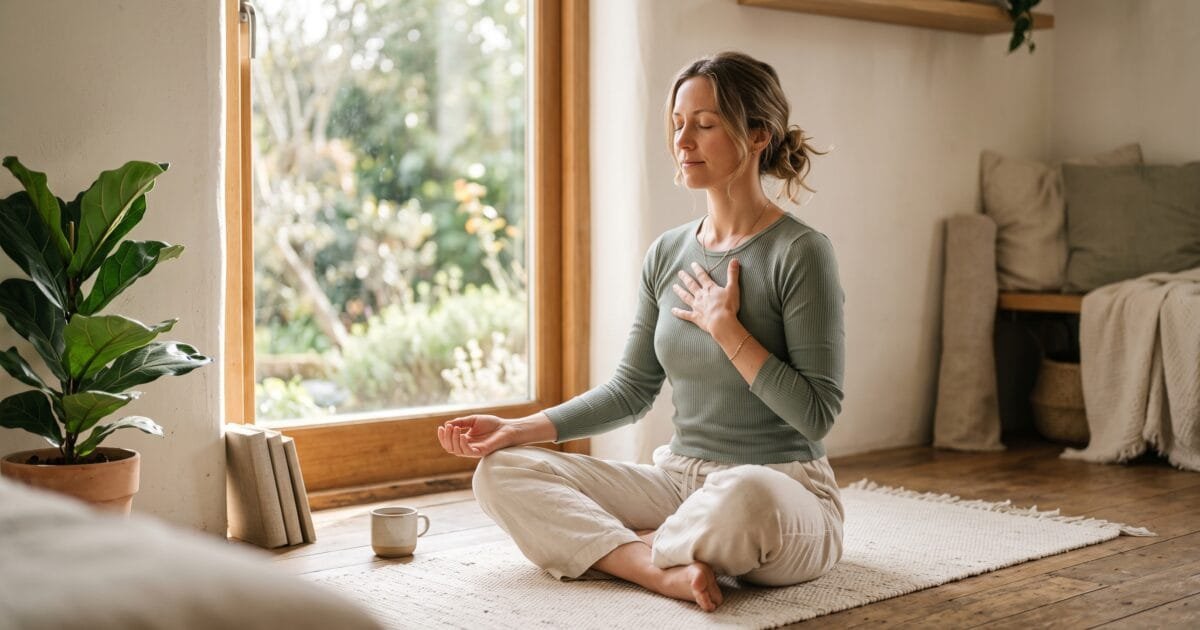
Hi, I’m Sophia. If you’ve ever been handed the advice “just breathe” in the middle of a stressful moment and thought, okay, but how, exactly — this one’s for you. Box breathing is one of the simplest, most teachable breathing patterns out there, and unlike a lot of wellness advice, it doesn’t ask for equipment, an app, or ten quiet minutes you don’t have. It asks for your breath and about sixty seconds.
It’s become popular partly because of its use in high-pressure fields like the military and emergency response, where people need a fast, reliable way to steady themselves under stress. You don’t need a high-stakes job to benefit from it, though — it works just as well before a hard conversation, during a 3 a.m. spiral, or in the middle of an ordinary overwhelming day.
What Is Box Breathing?
Box breathing — also called square breathing or four-square breathing — is a paced breathing pattern with four equal parts: inhale, hold, exhale, hold, each for the same count. The most common version uses a count of four:
- Inhale through your nose for a count of 4
- Hold the breath in for a count of 4
- Exhale through your nose or mouth for a count of 4
- Hold the breath out for a count of 4
Picture tracing the four equal sides of a square as you go — that’s where the name comes from. One full cycle takes about sixteen seconds; most people notice a shift after somewhere between four and eight cycles, roughly one to two minutes.
What’s Actually Happening in Your Body
Under stress, your breathing tends to get short, shallow, and fast — a pattern your brain reads as more evidence that something’s wrong, which keeps the stress response running. Slowing your breath down on purpose sends the opposite signal.
Breathing is one of the only automatic body functions you can also control voluntarily, and that control gives you real leverage over your stress response. Slow, even breathing — especially with a longer or equal exhale — is associated with increased activity in the parasympathetic nervous system, the “rest and digest” branch that counters the fight-or-flight state. Researchers studying this connect it partly to the vagus nerve, the main communication line between your brain and your organs, and partly to simple mechanics: slowing your breathing rate slows your heart rate, and a slower heart rate is itself a signal of safety to the nervous system. The pauses in box breathing aren’t just for counting — they give your body a moment to register that signal before the next breath begins.
None of this requires you to feel like an expert meditator. The mechanism is mechanical as much as mental, which is a big part of why it works even when your mind is racing.
How to Practice Box Breathing
- Sit or lie down somewhere reasonably comfortable. You don’t need to close your eyes if that feels uncomfortable — a soft, downward gaze works fine.
- Let your first breath out be a little longer than usual, just to reset.
- Inhale slowly through your nose for a count of 4.
- Hold gently for a count of 4 — no straining, no clenching your throat or chest.
- Exhale slowly for a count of 4, letting your shoulders drop.
- Hold the breath out for a count of 4.
- Repeat for 4–8 rounds, or until you notice your body settling.
If a count of 4 feels like too much — a little breathlessness or lightheadedness is common at first — scale it down to a count of 2 or 3 on each side instead. The equal-sided pattern matters more than the exact number. You can build up to a slower count over time as it starts to feel natural.
When Box Breathing Helps Most
Box breathing isn’t a cure for anything, but it’s a genuinely useful tool to reach for in specific moments:
- Before something stressful — a hard conversation, a presentation, a doctor’s appointment, an exam.
- In the middle of a stress spike — when your heart is racing or your thoughts are looping and you need something concrete to do with your body.
- At your desk — it’s quiet enough to do at your desk between meetings, and it doesn’t require lying down or leaving the room.
- Winding down at night — as one piece of a wind-down routine, though if sleep itself is the main issue, a technique with a longer exhale-to-inhale ratio (like the 4-7-8 breath in my guide on how to fall asleep fast) tends to be more specifically sedating than box breathing’s more neutral, alerting-but-calm rhythm.
That last distinction is worth sitting with: box breathing tends to leave people feeling calm and clear-headed rather than drowsy, which is exactly why it’s the technique reached for before a high-stakes moment rather than before bed. If your goal is specifically to fall asleep, an exhale-dominant pattern usually works a little better.
Box Breathing and the Wider World of Nervous-System Tools
Box breathing is one entry point into a much bigger toolkit for calming an activated nervous system. If sitting still and counting breaths isn’t the thing that helps on a given day, restorative yoga works the same nervous-system pathway through long, supported holds instead, and a guided meditation practice trains your attention rather than your breathing pattern specifically. For a broader set of ways to work with this same nerve directly, see my 8 vagus nerve exercises guide. For now, if racing thoughts are as much the problem as physical tension, it’s worth reading about how chronic stress affects your body more broadly — box breathing is a genuinely useful tool, but it works best alongside the bigger-picture habits (sleep, movement, boundaries) that keep your baseline stress lower to begin with.
Who Should Be Cautious
Box breathing is gentle for most people, but the breath-holds mean it isn’t automatically right for everyone:
- If you have a respiratory condition such as asthma or COPD, a cardiovascular condition, or are pregnant, check with your doctor before adding breath-holding practices to your routine, and skip or shorten the holds if anything feels off.
- Stop and breathe normally if you feel lightheaded, dizzy, or unusually short of breath — this usually just means the count is too long for you right now, not that something is wrong with the technique.
- Don’t practice while driving or operating machinery, since the point is to shift your attention inward.
- If anxiety is frequent, intense, or interfering with your life, breathing techniques are a helpful supplement to care, not a replacement for talking to a doctor or therapist.
A Simple Way to Start Today
You don’t need to wait for a crisis to try this. Pick one low-stakes moment today — right before you open your laptop, while the kettle boils, before you walk into the house after work — and run through four rounds. That’s it. The more you practice it when you’re calm, the more automatically your body reaches for it when you’re not.
I’m building out a full library of nervous-system tools like this one — breathwork, gentle movement, and mindfulness practices you can actually fit into a real day. If that’s useful to you, subscribing to the newsletter is the easiest way to hear about new guides as soon as they’re published.
And if stress is also showing up as trouble winding down at night, some readers find a bit of extra support from Attain’s Magnesium Glycinate Capsules ($27.99) alongside a wind-down practice like this one — magnesium glycinate is a well-absorbed, gentle form often used to support relaxation and sleep. It’s a complement to breathwork, not a substitute for it, and it’s worth a quick check with your doctor if you take other medications. Disclosure: Attain Supplements is part of our family of brands, so we may earn from purchases made through this link.
Related Reading
- Breathing Exercises for Anxiety: 6 Techniques That Calm You Fast
- 8 Vagus Nerve Exercises for a Calmer Nervous System
- Restorative Yoga: 8 Poses to Calm Your Nervous System
- Guided Meditation for Anxiety: A Beginner’s Script
- 50 Journaling Prompts for Stress and Self-Awareness
- Grounding Techniques for Anxiety: 6 Methods That Actually Work
⚕️ Disclaimer: This article is for general informational and educational purposes only and is not a substitute for professional medical advice, diagnosis, or treatment. Always consult a qualified healthcare provider before starting a new breathing practice if you have a heart, lung, or blood pressure condition, or are pregnant. Read our full medical disclaimer.


[…] mode and into something closer to reflection. It’s part of why journaling and slow, structured breathing pair so well — a few minutes of box breathing before you write can make it easier to actually […]
[…] mindfulness, like meditation or deep breathing, to reduce […]
[…] other nervous-system tools. If tight, shallow breathing is part of your stress pattern, my guide to box breathing is a good companion practice, and my breathing exercises for anxiety guide covers six techniques […]