
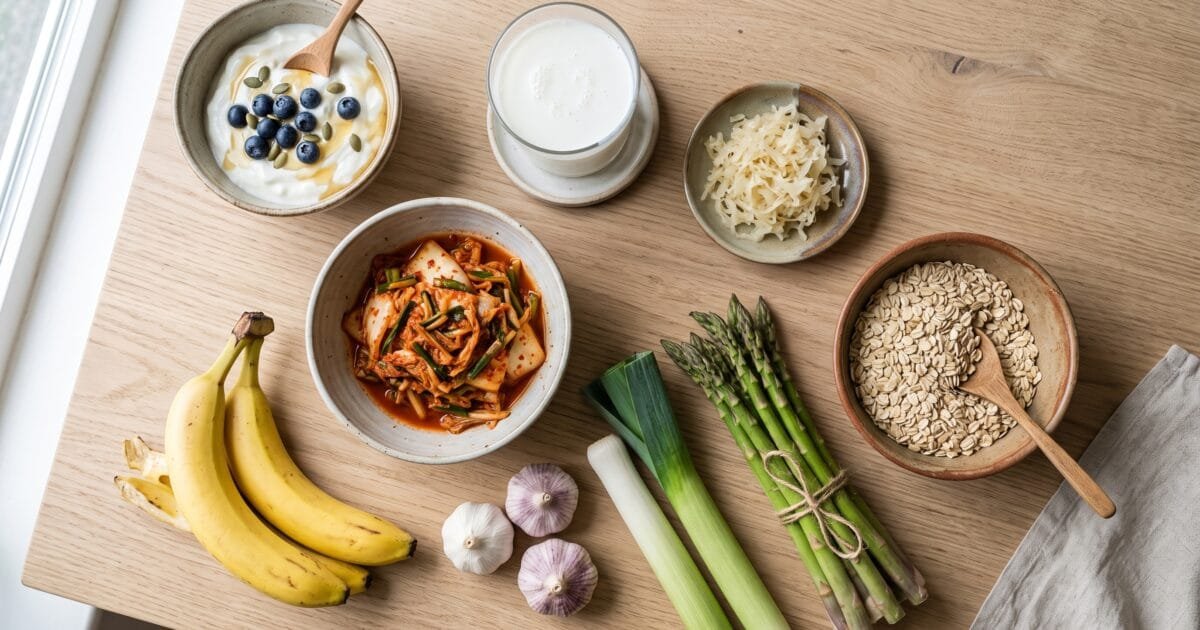
If you’ve ever stood in the supplement aisle wondering whether you need prebiotics, probiotics, or both — you’re not alone. The two words are nearly identical, they’re often sold side by side, and the marketing rarely explains what either one actually does. Hi, I’m Sophia. I spent an embarrassing amount of time confusing these two myself, so let me save you the trouble: probiotics are the beneficial bacteria; prebiotics are the food those bacteria eat. They’re not competitors — they’re teammates. In this guide, I’ll walk you through how each one works, the foods that deliver them, and how to decide which one (or both) your gut actually needs.
The Short Answer
Probiotics are live beneficial microorganisms — mostly bacteria from families like Lactobacillus and Bifidobacterium — that add helpful residents to your gut microbiome. You get them from fermented foods and supplements.
Prebiotics are specialized plant fibers your body can’t digest — but your gut bacteria can. They travel to your colon intact, where your beneficial microbes ferment them for fuel. Think of prebiotics as fertilizer for the good bacteria you already have.
Here’s the mechanism that makes this matter: when your gut bacteria ferment prebiotic fiber, they produce short-chain fatty acids (SCFAs) like butyrate — compounds that feed the cells lining your colon, calm inflammation, and help regulate everything from blood sugar to mood. A probiotic without food is a houseguest with an empty fridge. A prebiotic without a healthy bacterial population is fertilizer on bare soil. That’s why the two work best together.
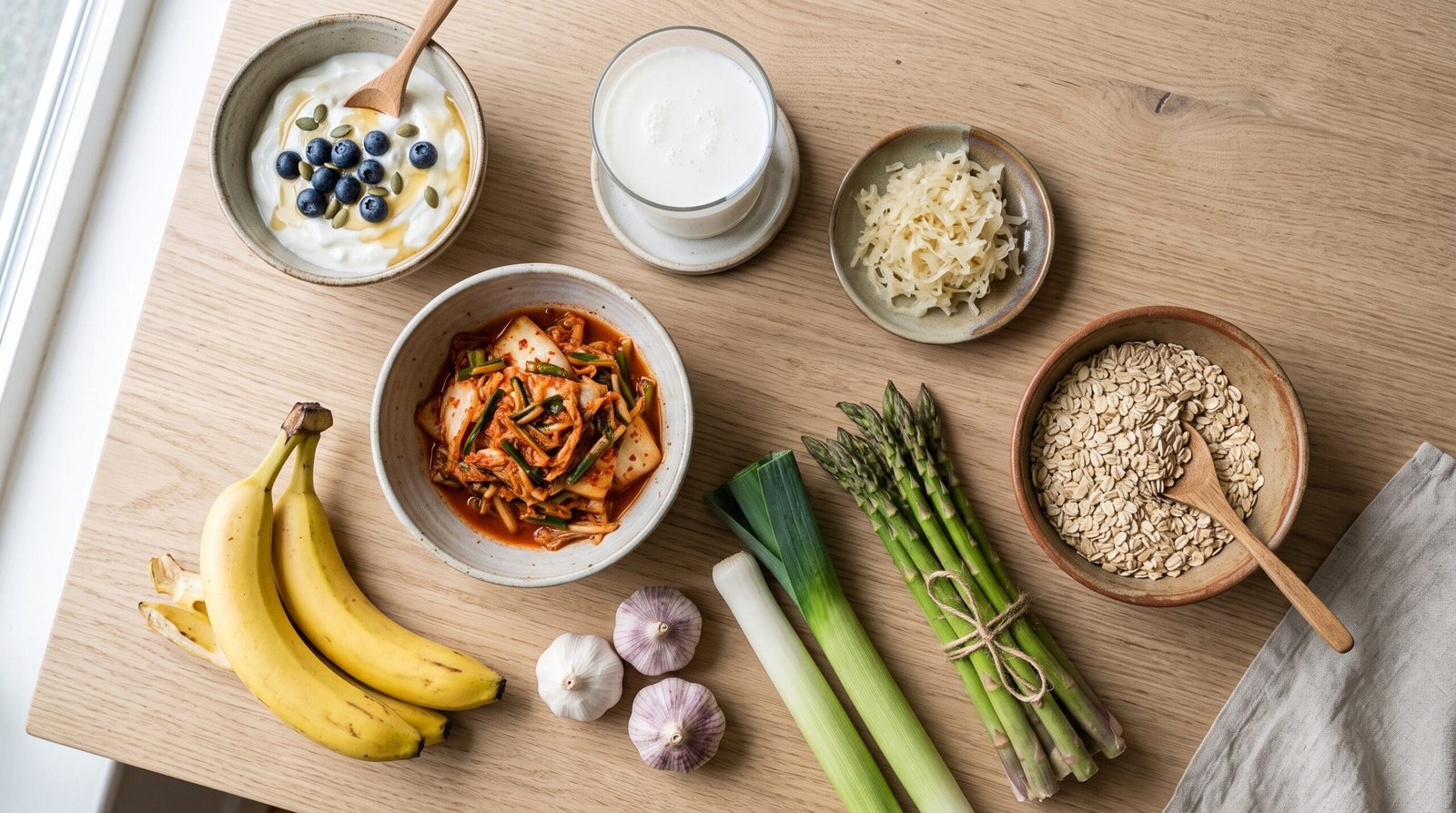
Prebiotics vs Probiotics: Side-by-Side
| Probiotics | Prebiotics | |
|---|---|---|
| What they are | Live beneficial bacteria and yeasts | Non-digestible plant fibers |
| What they do | Add helpful microbes to your gut | Feed the helpful microbes already there |
| Best food sources | Yogurt, kefir, sauerkraut, kimchi, miso, tempeh | Garlic, onions, leeks, asparagus, green bananas, oats, chicory root |
| Survivability | Fragile — many die in stomach acid or with heat | Sturdy — unaffected by stomach acid or cooking |
| How fast you notice | Often 2–4 weeks of consistent use | Often 1–2 weeks (sometimes temporary gas at first) |
| Common supplement form | Capsules measured in CFU | Powders/fibers like inulin, FOS, GOS |
What Probiotics Actually Do
Your gut is home to roughly 38 trillion microbes, and the balance between helpful and unhelpful species influences far more than digestion. Probiotics support that balance in a few specific ways: they compete with problematic bacteria for space and nutrients, they help maintain the gut lining (your barrier against toxins entering the bloodstream), and they interact with what Cleveland Clinic describes as the 70–80% of your immune system that lives in your gut.
That gut–immune overlap is also why fermented foods keep turning up in immune-supportive cooking. There are several live-culture options in my immune-boosting smoothie and recipe collection if you want somewhere practical to start.
The research is strongest for a few use cases — restoring your microbiome during and after a course of antibiotics, easing IBS symptoms like bloating and irregularity, and supporting regularity in general. The gut-mood connection is an exciting frontier too: your gut microbes help produce neurotransmitters, including most of your body’s serotonin. I’ve written a full guide on the gut-brain connection and anxiety if you want to go deeper there.
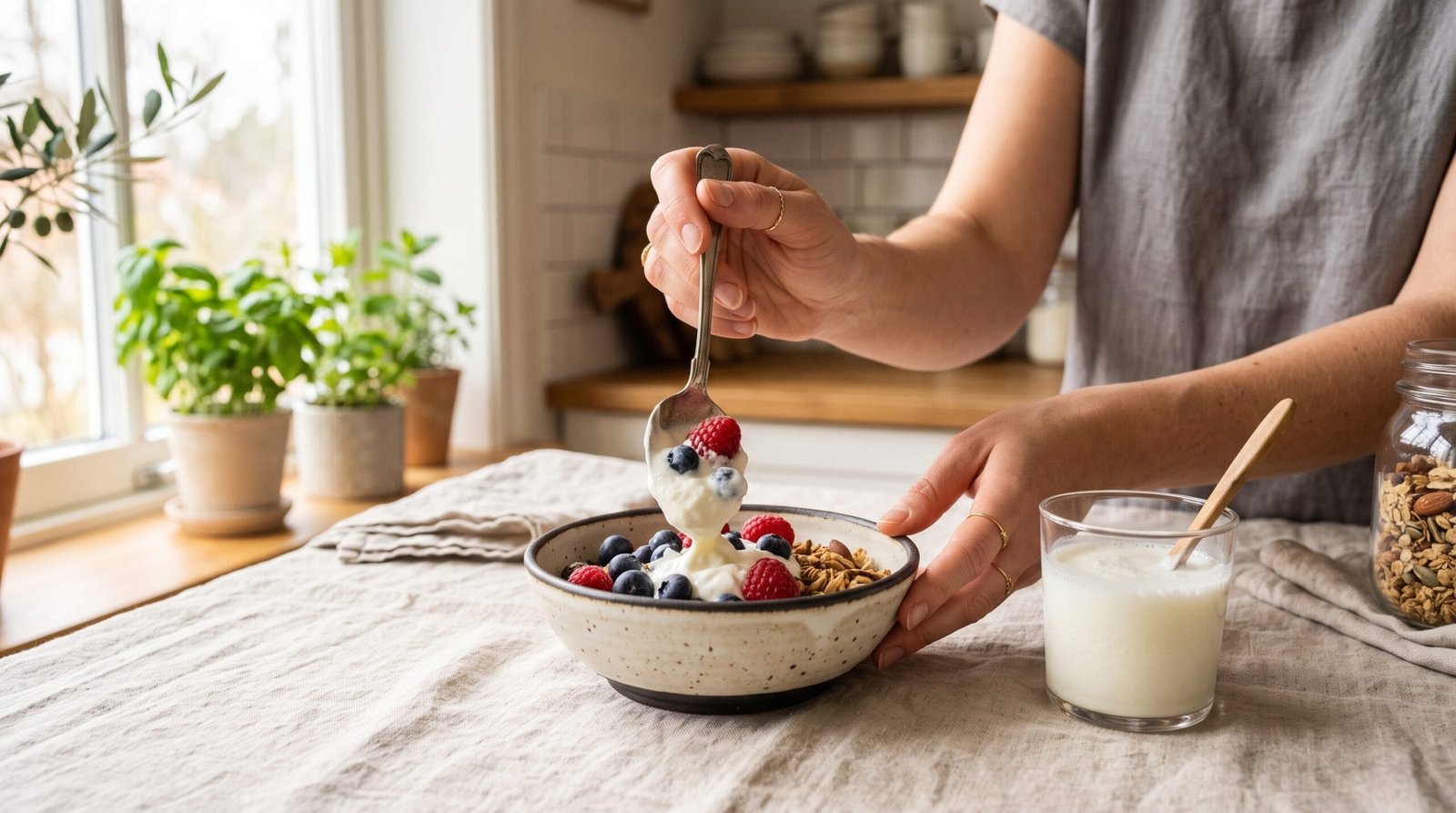
Probiotic-rich foods to rotate in:
- Plain yogurt with “live and active cultures” (check the label — many don’t survive processing)
- Kefir — a fermented milk drink with more strains than most yogurts
- Sauerkraut and kimchi (refrigerated, not shelf-stable — heat-treated versions have no live cultures)
- Miso and tempeh
- Kombucha (watch the sugar content)
What Prebiotics Actually Do
Prebiotics are, in my opinion, the most underrated tool in gut health. While probiotics get all the attention, studies consistently show that feeding your existing bacteria changes your microbiome more durably than adding new ones — because the bacteria you’ve had your whole life are better adapted to your gut than any newcomer.
When your microbes ferment prebiotic fibers like inulin, fructooligosaccharides (FOS), and resistant starch, the SCFAs they produce lower the pH of your colon (making it inhospitable to problematic species), strengthen the gut barrier, and dial down chronic low-grade inflammation — the same background inflammation I cover in my anti-inflammatory foods guide.
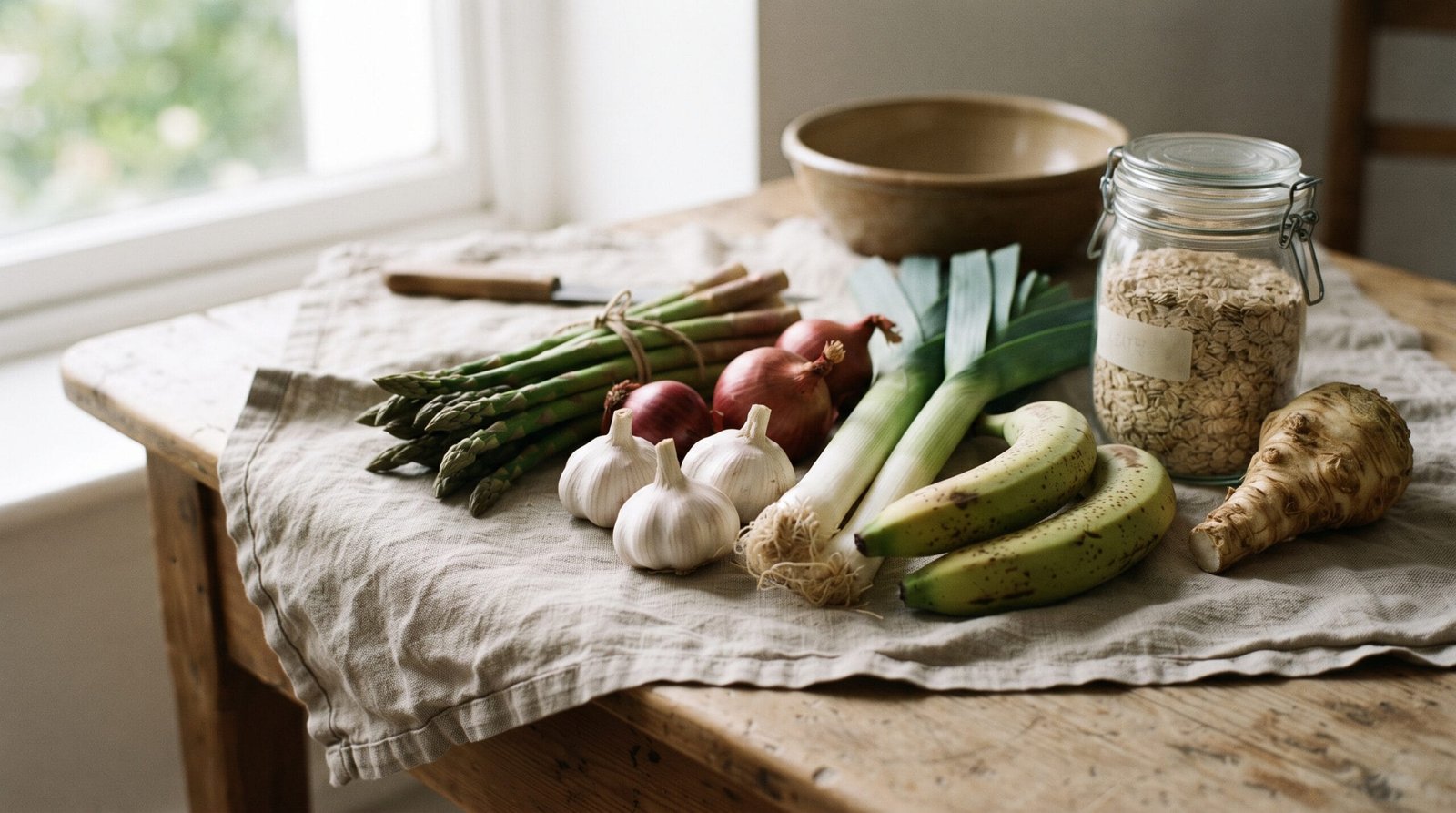
Prebiotic-rich foods to build meals around:
- Garlic, onions, and leeks (raw delivers the most, but cooked still counts)
- Asparagus and Jerusalem artichokes
- Slightly under-ripe bananas (the greener, the more resistant starch)
- Oats and barley
- Apples, with the skin on
- Chicory root — the richest natural source of inulin
A gentle heads-up from experience: if your fiber intake is currently low, ramp up slowly — add one prebiotic food every few days. Jumping from 10g to 30g of fiber overnight is a recipe for a noisy, gassy week. Your microbes need about 1–2 weeks to adjust.
So Which Do You Need?
Here’s the honest answer: most people need more prebiotics first. The average American eats about 15g of fiber a day against a recommended 25–38g — so for most of us, the existing good bacteria are underfed. Start there.
That said, probiotics make particular sense in a few situations:
- You’re on (or just finished) antibiotics. Antibiotics clear out beneficial species along with the infection. A quality probiotic during and for 2–4 weeks after can help repopulation.
- You have IBS-type symptoms. Bloating, irregularity, and discomfort respond to specific strains in multiple trials — Lactobacillus acidophilus and Bifidobacterium lactis are two of the best studied.
- You rarely eat fermented foods. If yogurt, kefir, and kimchi aren’t in your rotation, a supplement fills the gap.
- You’re under chronic stress. Stress hormones measurably alter your gut flora — it’s one of the high cortisol symptoms that flies under the radar. (Working on the stress itself matters too — here’s my guide to lowering cortisol naturally.)
And the good news for the overwhelmed: you don’t have to choose. Eating prebiotic foods and getting probiotics — from food or a supplement — is called a synbiotic approach, and it’s how the two were always meant to work.
The probiotic I recommend
If you’d rather not juggle multiple products, the one I point people to is Probiotic 40 Billion CFU from Attain Supplements ($19.99). A few reasons it earns the spot: it delivers 40 billion CFU across four research-backed strains (including the well-studied Lactobacillus acidophilus), and it uses MAKTREK® Bi-Pass Technology — a delivery system designed to protect the bacteria through stomach acid so more of them actually reach your colon alive, which is where most cheap probiotics fail. It’s a simple once-daily capsule, and pairing it with the prebiotic foods above gives those new bacteria something to eat when they arrive.
As always: this is wellness education, not medical advice. If you’re immunocompromised, pregnant, or managing a GI condition, talk with your doctor before starting any probiotic.
How to Put This Together (A Simple Week-One Plan)
- Days 1–3: Add one probiotic food daily (yogurt at breakfast is the easiest on-ramp, and my anti-inflammatory breakfast ideas guide has several yogurt- and oat-based options) and one prebiotic food (oats, a banana, or sautéed onions with dinner).
- Days 4–7: Add a second prebiotic source. Aim for 2–3 different plant fibers a day — diversity feeds diverse bacteria.
- Ongoing: If you fit one of the four probiotic scenarios above, add a supplement with breakfast. Give the whole routine 3–4 weeks before judging results — microbiome shifts are real but not instant.
- Support the foundations: your microbes also respond to sleep and stress, not just food. Poor sleep alone can shift your gut flora within two nights — if that’s your weak spot, start with my guide on how to fall asleep fast.
For the bigger dietary picture — which everyday foods feed beneficial bacteria and which quietly harm them — my full guide to gut health and nutrition picks up where this one leaves off.
Frequently Asked Questions
Can I take prebiotics and probiotics together?
Yes — and you arguably should. Taking them together (a “synbiotic” approach) means the beneficial bacteria arrive with their food supply. There’s no interaction to worry about; many supplements now combine both.
Which is better for bloating: prebiotics or probiotics?
Probiotics usually help bloating sooner — specific strains have reduced bloating in IBS trials within 4 weeks. Prebiotics can temporarily increase gas in the first week or two while your microbiome adjusts, then typically improve things. If bloating is your main complaint, start with a probiotic and add prebiotic foods slowly.
Do probiotics survive stomach acid?
Many don’t — that’s the biggest weakness of low-quality supplements. Look for acid-resistant delivery technology, strains chosen for survivability, or enteric-coated capsules. With food sources, eating them with a meal buffers stomach acid and improves survival.
How long does it take for probiotics to work?
Most studies showing benefits run 4–8 weeks. As a rule of thumb: give a daily probiotic at least 4 weeks before deciding whether it’s helping. Digestive changes often show up first; broader effects take longer.
Are prebiotic supplements necessary, or is food enough?
For most people, food is enough — and better, because whole foods deliver polyphenols and nutrient diversity a powder can’t. (Many of the best prebiotic foods are also antioxidant powerhouses.) A supplement like inulin powder makes sense mainly if you struggle to eat 25g+ of fiber daily.
Should I take probiotics every day?
Consistency matters more than timing. Most probiotic strains don’t permanently colonize your gut — they help while they’re passing through — so daily use is what maintains the benefit.
The Bottom Line
Prebiotics and probiotics aren’t rivals — they’re two halves of the same strategy. Probiotics add beneficial bacteria; prebiotics feed them. Most people should start by feeding the microbes they already have: 2–3 prebiotic plant foods a day, ramped up gently. Add probiotics — from fermented foods or a well-made supplement — if you’re recovering from antibiotics, managing IBS-type symptoms, or short on fermented foods. Give it 3–4 weeks, and let consistency do the quiet work. Your gut has been waiting to be fed properly — and you don’t need anything extreme to start tonight’s dinner off right. You’ve got this.
This article is for educational purposes and isn’t a substitute for personalized medical advice. If you have a digestive condition or take medication, check with your healthcare provider before adding supplements.

[…] gut. They work differently from the fiber that feeds those bacteria, a distinction I break down in prebiotics vs probiotics. A landmark 2021 Stanford study found that a high-fermented-food diet significantly increased […]
[…] Unlike refined grains (white rice, white bread, pasta) which spike blood sugar and drive inflammatory responses, whole grains deliver fiber that feeds anti-inflammatory gut bacteria and reduces systemic CRP levels. That fiber is acting as a prebiotic, which is worth understanding if you’re deciding between prebiotics and probiotics. […]
[…] beneficial bacteria through fiber and fermented foods, and understanding the difference between prebiotics and probiotics, is one of the more evidence-backed ways to support immune resilience long […]
[…] fermented foods like yogurt and kombucha. If you’re not sure which is doing what, my guide to prebiotics vs probiotics explains the […]